
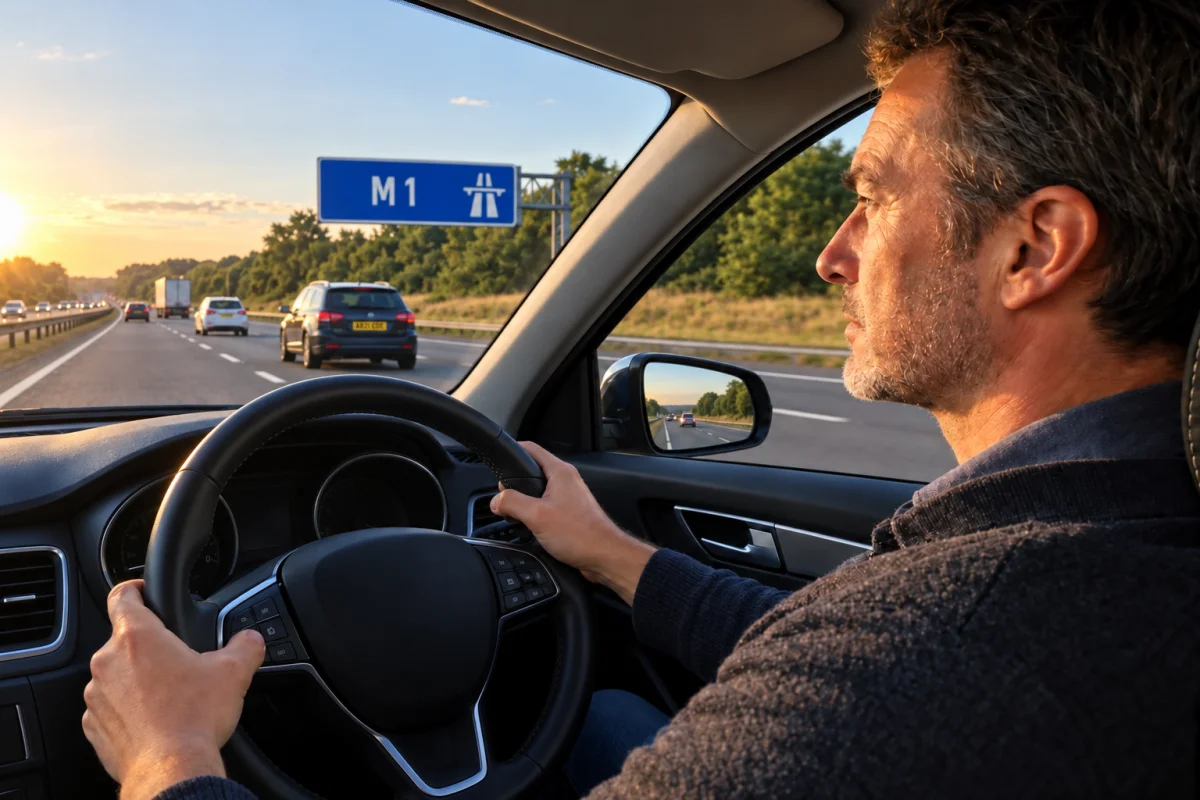
On a long motorway run, the cruise control sits at 70 and the question nags: would 60 really make a difference to the fuel gauge, and how much later would you arrive?
The fuel saved is real but modest. The time lost is less than the arithmetic suggests. And two things on the car itself can matter as much as the speed.
Ten mph less over 300 miles: how many litres and pounds
The Department for Transport's own figure is that driving at 70 mph uses up to 9% more fuel than at 60 mph. Slowing from 70 to 60 saves at most about one litre in twelve, depending on the car and the conditions.
Take a 300-mile trip in a car doing 45 mpg at 70 mph. That is about 30.3 litres. At 60 mph, it comes down by up to 2.5 litres. DESNZ put the average UK pump price at 173.46p a litre for petrol and 197.58p for diesel in the week of 28 September 2026, which makes the saving worth up to £4.34 in petrol or £4.94 in diesel. Fill up at a motorway services and the stakes rise: the competition watchdog found motorway petrol up to 26p a litre dearer than off the motorway.
Prices move every week, so treat them as an order of magnitude. Our piece on how much a different forecourt can save covers where you buy.
43 minutes more, on paper: the real price of slowing down
On paper, 300 miles at 60 instead of 70 costs 43 minutes. In practice it costs less. Roadworks at 50, queues, junctions and a stop for coffee pull the average down, and only the stretches actually driven at full speed lose time. A weekend trip through busy sections barely spends an hour at 70 anyway.
Splitting the difference at 65 costs 20 minutes on paper, less than half the time lost at 60, for part of the saving.
Why the last few mph cost the most
At motorway speed, most of the engine's effort goes into pushing air out of the way, and air resistance rises with the square of the speed. Going from 60 to 70 is about 17% faster, but it means roughly 36% more air resistance.
That is where inflated claims come from: drag alone would suggest a far bigger fuel penalty. In real driving, tyre friction, engine efficiency and gradients dilute it, which is why the government's figure is "up to 9%". Each mph you knock off saves a little less than the one before. In town, it is stopping and starting that burns fuel, not air resistance. Electric cars follow the same physics: the battery drains noticeably faster at 70 than at 60.
Before the next long trip: three checks
Two leaks go unnoticed on most cars, and both work against you on every mile, whatever speed you choose. A roof box, roof bars or a bike rack left on when empty adds drag on every motorway mile. Under-inflated tyres add rolling resistance all the time.
- Set the cruise control on clear stretches: it avoids the sharp accelerations that cancel out the gain.
- Check tyre pressures cold, at least once a month, after the car has stood for a couple of hours, to the figure inside the driver's door or the fuel flap, using the laden figure for a loaded car.
- Take off empty roof boxes, bars and racks before you set off.
Two smaller habits complete the list:
- Fill up before the motorway: services can charge a hefty premium per litre.
- Weigh up air con and open windows: both cost fuel, and at motorway speed open windows add drag.