
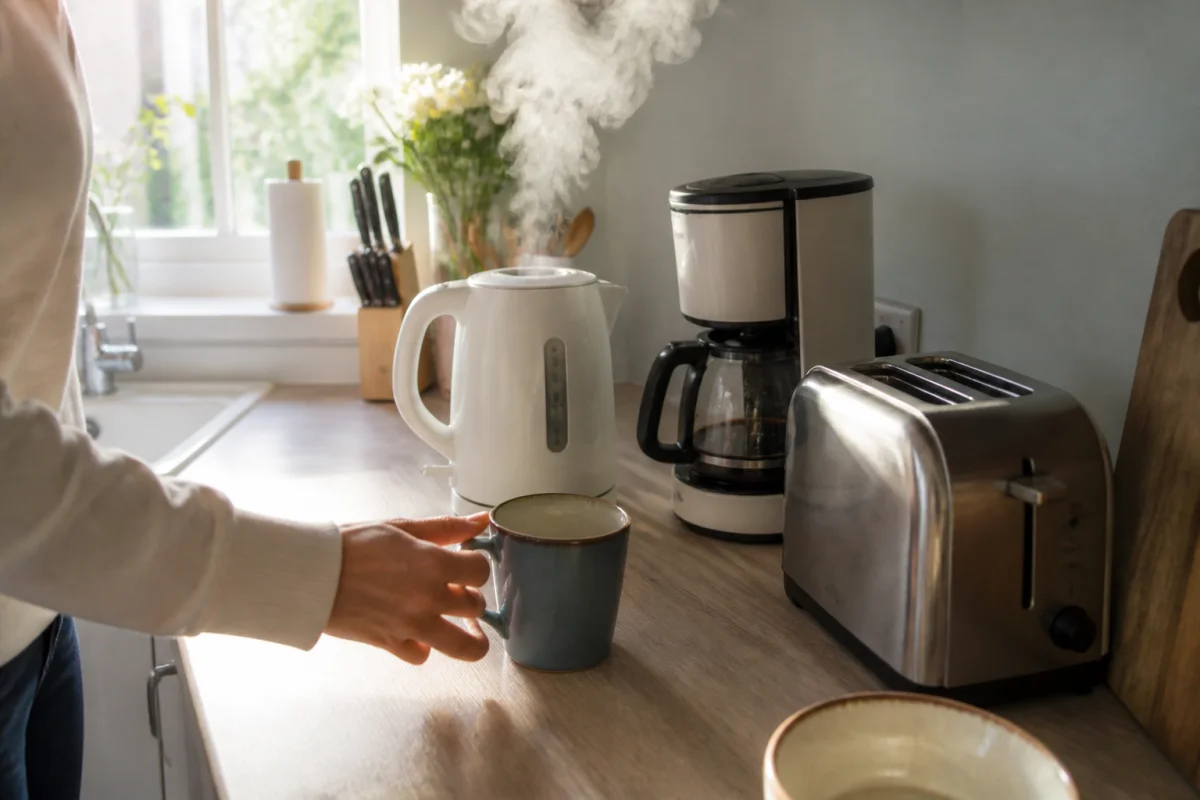
The British morning has a soundtrack: the click of the kettle, the pop of the toaster, the gurgle of the coffee machine. We rarely connect those sounds to the energy bill, yet every one of these appliances leaves a mark on our consumption. The real question is not which one draws the most power, but which one quietly costs the most across a whole year.
An energy bill never looks at power on its own: it multiplies power by how long the appliance runs and by how often you switch it on. A 3,000 watt device on for a minute uses less than a 100 watt one left on for an hour. That single rule reshuffles the whole breakfast table.
The kettle looks alarming but barely runs
The kettle is the most powerful thing on most worktops, often rated at 3,000 watts. The figure looks frightening, but the working time is tiny. Boiling enough water for a couple of mugs takes around two minutes, roughly 0.10 kWh. At the Ofgem price cap of about 26p per kWh, that is a little under 3p a time, close to £10 a year for a once-a-day boil.
The waste creeps in when the kettle is filled to the top just to make one cup. Heating half a litre of water you never use, every single day, means paying for warmth that goes straight down the sink.
Good to know: filling the kettle only to the mugs you actually need can save around 18 kWh a year, with no change at all to your routine.
The coffee machine and the hot plate that heats nothing
A pod or filter machine draws around 1,200 watts, but it only truly works while it heats and brews, a few minutes at most. Two morning coffees come to about 0.10 kWh a day, a little under 3p, close to £10 a year.
Filter machines with a warming plate tell a different story. Keeping the jug hot for an hour uses as much electricity as brewing the coffee in the first place: a 100 watt plate left on adds another 0.10 kWh a day, and leaving it on all morning quietly doubles what your coffee costs.
Switching the plate off once the pot is poured, or decanting into a thermal jug, is the single most effective habit. The comparison across appliances is set out in the guide to household appliances.
Toaster and microwave, the gentle ones
The toaster averages about 1,000 watts and runs for two or three minutes, which works out at roughly 0.05 kWh a morning, barely more than a penny, well under £5 a year. A microwave used to warm milk or porridge sits even lower, around £3 a year for a couple of minutes a day.
The appliances that sound the most aggressive are the ones that weigh least on the bill, simply because their work is over in moments. The same logic runs right through the kitchen and shows up clearly once you read a bill in kWh; our explainer on the kWh unpacks it.
A ranking the wattage never gave away
Lined up side by side, the breakfast appliances turn intuition on its head: the most powerful are not the dearest, because they switch off so fast. What costs is whatever is left running for nothing, like the coffee warming plate.
To picture your own case, add up the kWh of the three appliances you actually use each morning and multiply by the days in the year and the price of electricity.
Where the cost really hides
Add up the kettle, the coffee and the toaster and a typical electric breakfast still comes to under £25 a year. The number is not the problem; the habits that inflate it are: water heated in excess, plates left on, appliances idling on standby.
Cutting the dead time matters more than giving up any single appliance. Here is what pays off in the morning and what to avoid:
- Fill the kettle to the mugs you need: boiling only what you drink is the biggest single saving of the morning.
- Switch the coffee plate off the moment the pot is poured: an idle warming plate can cost as much as the brew itself.
- Decant coffee into a thermal jug if you sip it over the morning, rather than reheating it on the plate.
- Don't reboil a full kettle for a single cup: you pay for litres of water that go cold and get tipped away.
- Don't leave the warming plate on after breakfast: an hour of empty heating doubles the cost of your coffee.
- Don't judge an appliance by its wattage: a brief 3,000 watt burst is cheaper than a slow 100 watt drain.
Anyone wanting to go further, from standby drains to picking the right tariff, will find more in our guide on how to save electricity.
- What to remember
- The powerful appliances are brief and cheap: kettle, toaster and coffee machine each cost under £10 a year.
- The hidden cost is idle running time, above all the coffee warming plate.
- The whole electric breakfast stays under £25 a year when nothing is left on for nothing.