
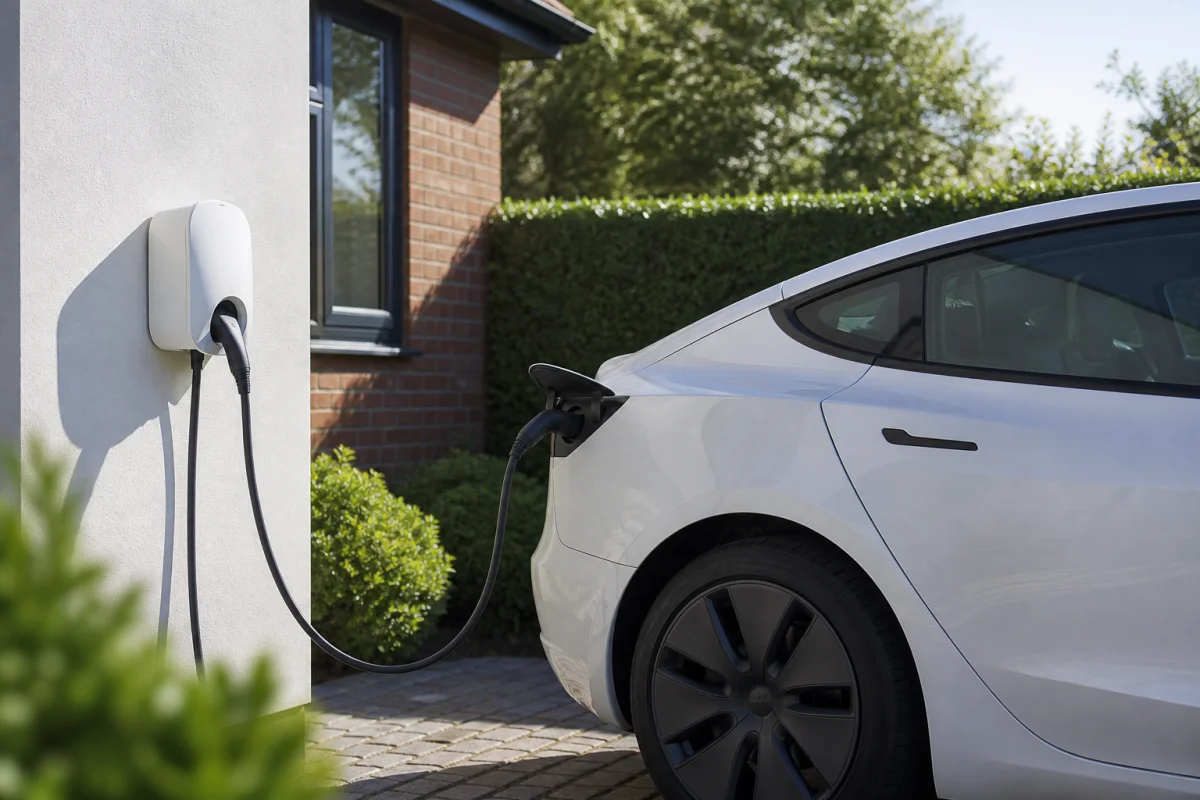
Every electric car comes with a cable that fits an ordinary three-pin socket, so it is tempting to think the charging question is already settled. Plug in, walk away, done.
It is not quite that simple. What you plug into decides how fast the car charges, whether your wiring stays cool over a long session, and how much a proper installation will cost. Get those three right and home charging becomes the cheapest, most convenient way to run an electric car in Britain.
The three-pin plug: possible, but slow and built for other things
A standard domestic socket delivers roughly 2.3 kW, which adds only about 10 miles of range an hour. For a small top-up that is fine. For a big battery it means well over a day and a half from empty, so the car is effectively tied to the driveway.
The bigger issue is heat. Household sockets and the wiring behind them were never designed to carry a heavy load continuously for hours on end. On older or worn circuits that sustained draw can make connections run hot, which is exactly the kind of demand our guide to how much appliances use flags as unusual for a home ring main.
Use the three-pin lead as an occasional backup, not your daily method.
The commando socket: a step up, still a workaround
A blue 16 A commando socket, the industrial-style connector you see on caravan pitches, delivers around 3.7 kW when wired onto its own dedicated circuit. That is noticeably quicker than a three-pin plug and far safer, because the socket and cable are rated for the job and are not sharing a circuit with the kettle and the washing machine.
It is a sensible middle option if a full wallbox is out of budget for now. What you do not get is any intelligence: no scheduling, no app, no automatic power management. You are simply plugging into a sturdier socket.
The 7kW wallbox: built for charging overnight
A single-phase 7kW wallbox is the option designed from the ground up for home charging. It roughly triples the speed of a three-pin plug and comfortably refills most cars while you sleep, which is why a wallbox turns charging into something you never have to think about.
Beyond raw speed, it adds the features that make daily charging painless:
- Faster charging at around 7 kW, enough for a full overnight refill on a typical battery.
- Smart scheduling so the car starts charging automatically inside your cheap off-peak window.
- Power control that manages the draw safely and, on many units, balances against the rest of the house.
- A fixed, weatherproof unit on a dedicated circuit rather than a loose cable trailing across the drive.
Expect to pay roughly £800 to £1,200 fitted by an approved electrician, depending on the unit and how far the cable has to run from your consumer unit.
Charge the right way, whatever you plug into
Whichever route you pick, the safety rules are the same, and they matter most on the slow options where the car draws power for hours at a stretch.
- Programme the charge overnight on a dedicated circuit, so the load sits on wiring that is rated for it.
- Have the connection checked by a qualified electrician before you rely on it night after night.
- Do not charge for hours on a cheap extension lead or multiway adaptor, which can overheat under a sustained load.
- Do not treat a three-pin socket as your everyday method if you drive real mileage.
Good to know: a dedicated circuit is not just about speed. It isolates the charger from the rest of the house so a long session never overloads a ring main shared with other appliances.
When you charge matters more than what you plug into
Here is the part that saves real money. The connector sets your speed, but the tariff you charge on decides what a mile actually costs. Under the current price cap you pay around 26p per kWh, whereas a dedicated overnight EV tariff can drop to roughly 7p per kWh.
On those numbers a full home charge works out at about £17, against roughly £53 for the same energy at a public rapid charger. Understanding your consumption in kWh is the key to seeing that gap, and there are more ways to trim the bill in our guide to saving electricity.
So pick the connector that suits your mileage and budget, but put at least as much effort into the tariff behind it. A cheap overnight rate is what turns an electric car into a genuinely low running cost.