
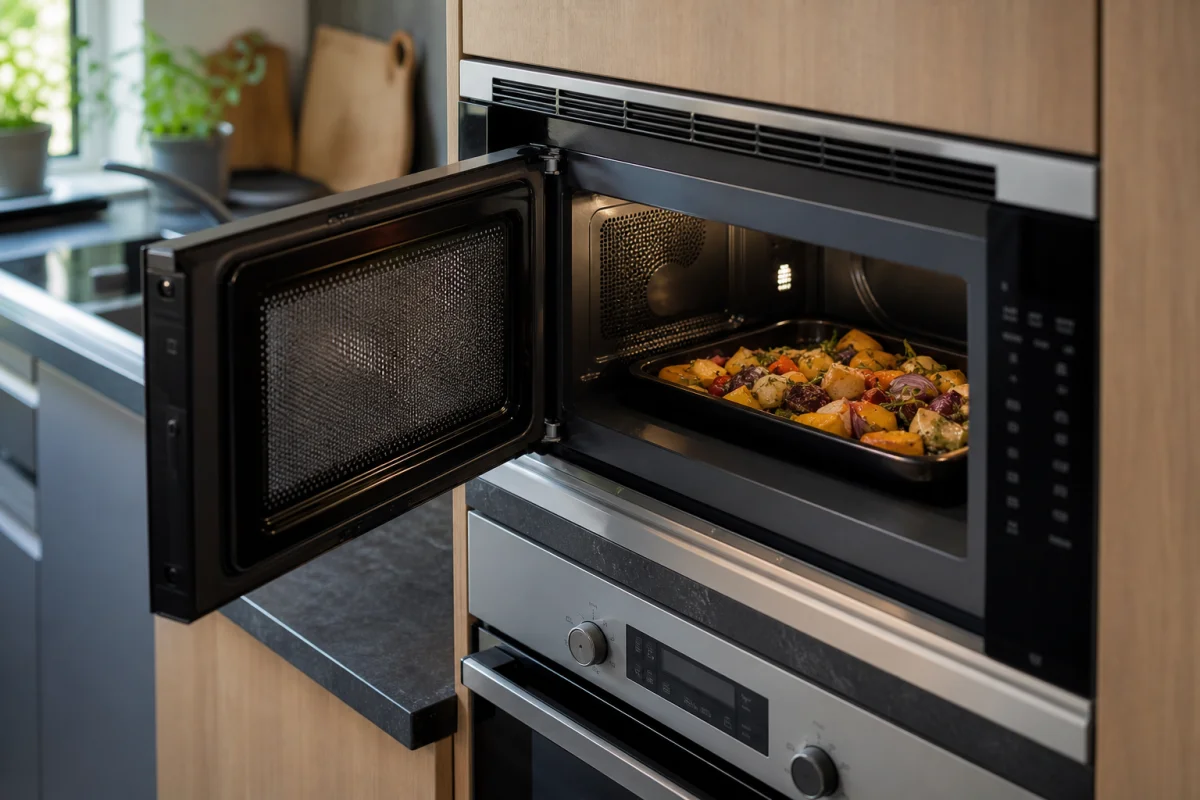
It takes up little room, heats up fast and now does far more than warm up leftovers. The combination microwave, which pairs the microwave with a fan and a grill, is often sold as a stand-in for the conventional oven. For a good share of everyday meals the promise holds up, but the saving on the bill is smaller than it looks and it does not suit every home.
Three ways to heat in one cavity
A plain microwave heats only from within, by agitating the water molecules in the food: fast, but it neither browns nor crisps. A combination model adds a heating element and a fan, so it can grill, roast and cook like a small fan oven, on its own or alongside the microwave. It is that pairing that cuts the time, because the microwaves heat right through while the grill crisps the surface.
On paper the power ratings are close. A 32-litre combination unit is rated at roughly 900 W on microwave, 1,500 W on the grill and 2,100 W on convection, drawing at most around 2,900 W. A conventional electric oven usually sits between 2,500 and 3,000 W. The real difference is not the power rating but the volume you have to heat and how long the appliance stays on.
Cavity size does the heavy lifting
A conventional oven needs preheating and warms a large cavity even for a single portion. A combination model works on a smaller space with no long preheat, so for the same dish it draws less.
On a single cook, a 32-litre combination unit uses about 0.45 kWh, against 0.78 kWh for a standard 65-litre oven and 0.59 kWh for a compact 45-litre model. It looks trivial, but repeated across a year the gap becomes real.
At roughly 187 cooks a year and around 26p per kWh, the combination unit costs a little under £22 a year on the bill, against nearly £29 for a compact oven and about £38 for a standard one. The saving against the big oven comes to around £16 a year: real, but not on its own a reason to buy. Our guide to saving electricity in the kitchen puts the figures in context.
Where the combination unit is plenty
The combination model is at its best on small amounts, where firing up the big oven would be a waste. Reheating a plate costs 0.05 to 0.06 kWh in the microwave, against 0.45 kWh for the same plate warmed through in the oven: almost ten times less.
- Single portions and quick dishes: a fish fillet, a small tray of potatoes, vegetables to brown off.
- Reheating and defrosting: the microwave is unbeatable here, at a few pence a plate.
- Browning and crisping: the grill gives the finish a plain microwave cannot.
The 34.5 cm turntable and 23 cm of cavity height are enough for most everyday dishes.
Where it falls short, and the threshold that decides
The combination unit does not win every time. For large quantities the conventional oven is better suited and often more efficient too, because it heats everything at once.
The threshold is a question of volume. Two batches in the combination unit use about 0.90 kWh, more than the 0.78 kWh of a single tray in the 65-litre oven, and take a good half-hour longer. From the second tray onward, the big oven comes back in front.
- Big batches: lasagne for eight, the Sunday roast, several trays at once.
- Long, repeated cooks: the combination unit loses its edge on both time and energy.
Good to know: if you keep the oven, cook on the fan setting rather than conventional heat, and save the pyrolytic self-clean (3 to 5 kWh a cycle) for when it is genuinely needed. Two habits that cut the running cost without changing a single appliance.
The real trade-off is space and household size
In the end the bill matters less than the space. In a studio or a kitchen with no built-in units, for one or two people, a good combination microwave frees up a whole cupboard and replaces the oven for almost every everyday job: that is worth more than the few pence saved.
For four people or more, batch-cooking often, it makes more sense to keep the oven for full meals and use the combination unit for reheating and small cooks. The right choice comes down to the size of the household and the space in the kitchen, not the £16 a year.
- In short
- One or two people, tight on space: the combination unit can replace the oven.
- A larger household: oven for full meals, combination unit for the rest.
- Either way: heating only the volume you need stays the most effective habit, and our guide to the kWh helps you read the running costs on the label.