
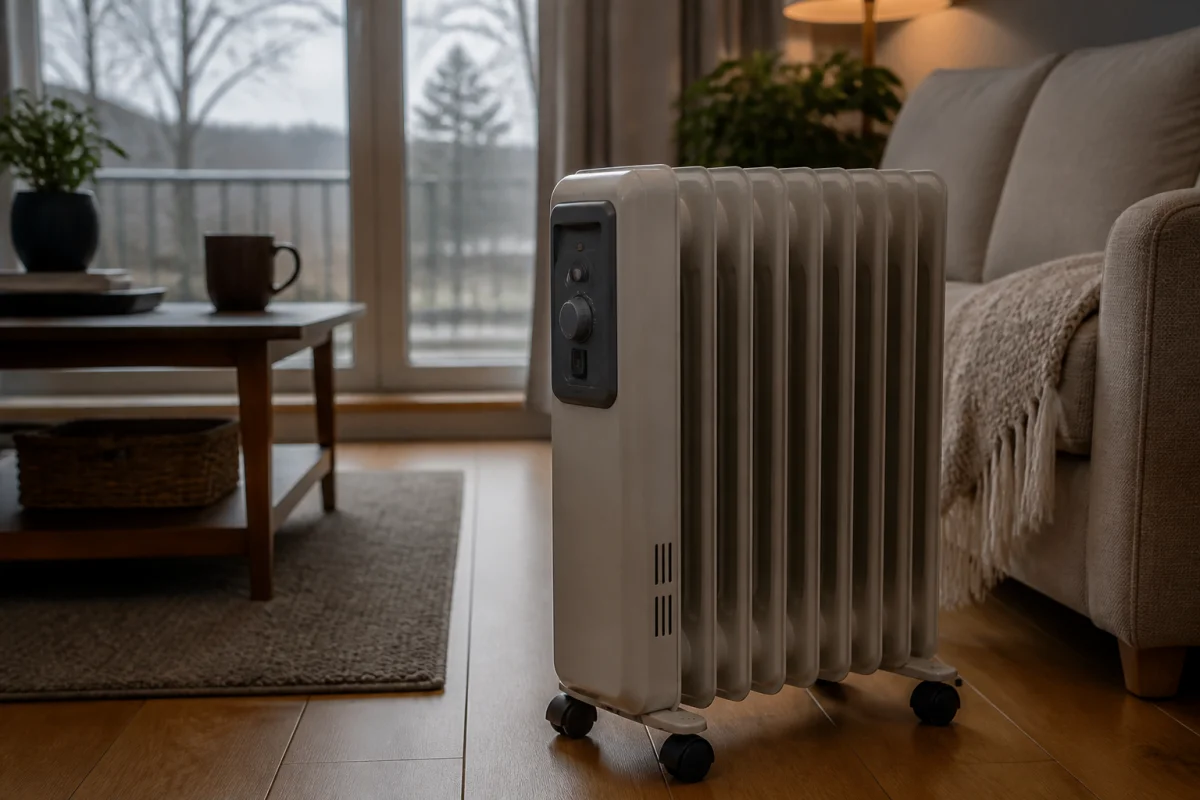
As the first cold snap arrives, the plug-in electric heater comes back out in millions of British homes: to warm the bathroom quickly in the morning, or to heat a single room without switching on the whole central heating system. Before you tuck one beside the sofa, it is worth knowing what it really adds to your bill, and when it actually makes sense, because the gap between a fan heater, an oil-filled radiator and a convector is not the one most people expect.
The cost depends on the wattage, not the technology
A direct-acting electric heater turns all of the electricity it draws into heat. At the same power and the same running time, every one of these appliances uses exactly the same amount of energy: what changes is comfort (how fast the room warms, the noise, how dry the air feels, how long the heat lingers), not the number of units pulled from the socket.
The hourly cost is therefore easy to work out: the power in kilowatts multiplied by your unit rate. At the current cap of around 26.11p per kWh, one hour of running comes out like this:
- A 2,000W fan heater: about 52p an hour, heat almost instantly but gone the moment you switch it off.
- A 2,000W oil-filled radiator: about 52p an hour, slower to warm up but holding its heat well afterwards.
- A 1,500W convector: about 39p an hour, quiet background warmth that fades fast once off.
- A 1,000W radiant panel: about 26p an hour, warming you rather than the whole room.
Put your own figures in below to see what your heater really costs, per day and per month:
So anyone hunting for the "cheapest" model is looking at the wrong thing: what drives the bill is the wattage you pick and the hours you run it, not the label on the box. To see how it stacks up against everything else you plug in, our guide to appliance running costs is a useful reference.
Which heater suits which room
Because the running cost comes down to wattage, the useful question is not "which is cheapest" but "which does the job in the fewest minutes". Each type has a room it was made for.
The pattern is simple: a fan heater earns its keep in short, sharp bursts, an oil-filled radiator in a room you occupy for hours, and a radiant panel where you only need to warm the people in front of it.
Good to know: as a rule of thumb, allow around 100W of heater for every square metre of room. A 1,000W panel comfortably covers a 10 m² study, so a 2,000W blast there just burns money to reach the same temperature faster.
When a plug-in heater helps and when it becomes a trap
An electric heater is at its best as a targeted, short-lived top-up: one occupied room for an hour, a quick boost in the milder shoulder months, a rarely used room warmed without firing up the whole system. Used that way the cost stays modest, simply because the hours are few.
The trouble starts when it becomes the main source of heat.
Three hours every evening with a 2,000W heater works out at roughly £1.57 a day, more than £45 a month for a single room, and that figure multiplies with every extra room you treat the same way. Run for long stretches across the house, a plug-in heater is one of the most expensive ways to keep warm. Before you lean on one all winter, it pays to tackle insulation and habits first:
- Heat only the room you are in, with the door shut, so the warmth is not leaking into empty space.
- Match the wattage to the room: a 1,000W panel is plenty for a small study, a 2,000W model is wasted there.
- Fix the draughts first: our tips on how to save electricity show where to start.
- Do not run one as whole-home heating: several rooms on plug-in heat is the priciest bill of all.
- Do not leave it going in an empty room: the heat is gone within minutes of switching off anyway.
Our guide to energy efficiency explains which fixes deliver the biggest savings over a full winter.
The safety rules that are never worth skipping
An electric heater draws a lot of current, and should be treated accordingly.
- Before you switch on
- Plug it straight into a wall socket, never an extension lead or multi-way adaptor, which can overheat under the load.
- Keep it clear of curtains, drying laundry and furniture, with space around it on every side.
- Never leave it running unattended, and keep it out of a child's bedroom overnight.
With a little care and targeted use, a bit of top-up heat stays a genuinely useful ally on the coldest days, without any nasty surprises on your bill.