
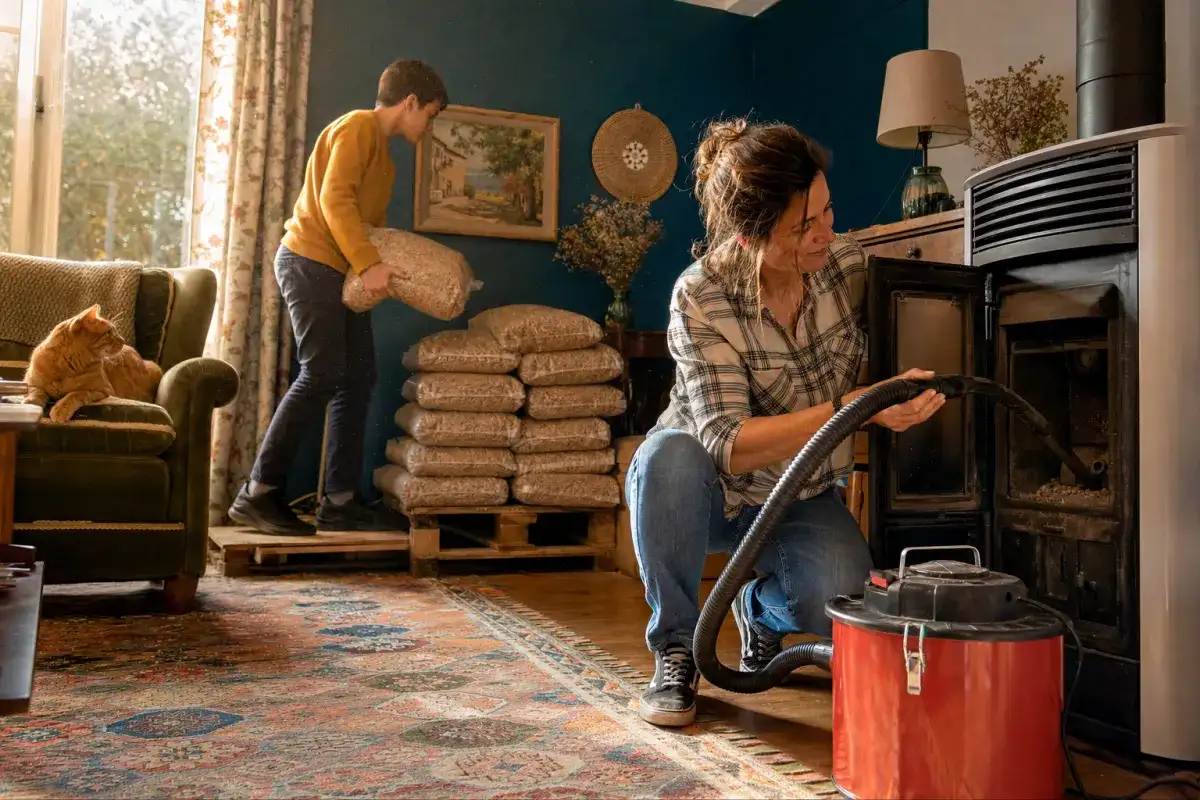
The first fire of the season is rarely the problem; the clean-up before it is, because most people work in the wrong order and go over everything twice. Ash falls downwards: what you touch first drops dust onto what comes next.
Do it cold, and unplugged if there is a mains lead. Then five jobs, in this order.
Five jobs, and the order does the work
- Take the burn pot or the grate out and brush it clear. On a pellet appliance it is the perforated basket the fuel drops into, and every hole is a combustion air route: scrape the crust off and check each one is open.
- Vacuum the ash pan, then the firebox, then the cavity underneath. Pull the pan out without dragging it across the door rope. The recess below the burn pot is where the fine ash collects, and the part everyone forgets.
- Test the door rope with a sheet of paper. Shut the door on it and pull. If it slides out with no resistance, the seal has flattened. Repeat on all four sides: one weak edge is enough.
- Empty the bottom of the hopper before you refill it. Under a season's pellets sits a layer of fines, the sawdust that works its way down. Vacuum it out, and on a log burner check the baffle is seated instead.
- Look at the flue terminal from outside. A nest, a summer's worth of leaves or a blocked cowl kills the draught on the very first burn, and you smell it in the room rather than see it.
The glass comes last, once the appliance is cold: wiping hot glass with a damp cloth is how it cracks.
The vacuum and the rope are where people come unstuck
A household vacuum is the most expensive mistake here. Wood ash passes straight through a paper bag and reaches the motor, and a live ember that goes in with it can set the bag alight. A fire that went out yesterday evening still holds embers today.
You want a dedicated ash vacuum with a metal drum and a fine particle filter, used on ash that is completely cold.
A flattened rope breaks nothing, which is why nobody notices. It lets air in around the door instead of through the inlets, and the appliance loses control of its combustion.
- Air leaking past the door burns the fuel faster than the appliance intends, so the same heat costs more bags or logs.
- The glass blackens within days, usually the first sign anyone notices.
- A pellet appliance fights its own sensors, because the air it meters is no longer the air it gets.
Where your own work has to stop
Nothing above touches the chimney, deliberately. Sweeping belongs to a sweep registered with a recognised body such as HETAS, and the guidance for wood is every quarter while the appliance is in use, not one visit in September. A pellet appliance follows the manufacturer's schedule: normally an annual strip-down of the flue ways by an engineer.
Keep the sweep certificate: insurers commonly ask for one after a chimney fire.
If the appliance has stood unused for a full year, book the sweep before you light it, not after. A carbon monoxide alarm belongs in the same room, and rented homes in England have needed one in any room with a fixed combustion appliance since 1 October 2022. Press its test button while you are there. Wood burner or pellet stove is a separate question, settled by the running costs of each.
Damp fuel is the number one call-out
Most failures in the fortnight after a restart come from the fuel, not the appliance. A pellet that has picked up moisture swells, crumbles and jams the auger. Wet wood spends its energy boiling water off instead of heating the room.
- Store the fuel indoors, dry and raised off the floor on a pallet. A ventilated garage or cellar is fine; a shed only if it genuinely stays dry.
- Keep the bags shut and open only the one you are using. An open bag in a cold room draws moisture from the air for weeks.
- Buy certified fuel. Pellets carry ENplus or DINplus, and any wood or manufactured fuel sold in small volumes in England has to be Ready to Burn certified at 20% moisture or less.
- In a smoke control area the appliance matters as much as the fuel, since burning wood there requires an exempt appliance.
The smell in the first ten minutes
A faint hot-dust smell on the first burn is normal, the summer's dust burning off the heat exchanger and the casings, and a window sees it off.
A smell of smoke does not clear, and means the draught is wrong or the door is not sealing: shut down and find out which before you relight. Keeping a home warm this winter assumes a stove that works with you.
Worth knowing: a chimney sweeping log from the supermarket does not replace a sweep. It loosens some deposits between visits, and nothing more.