
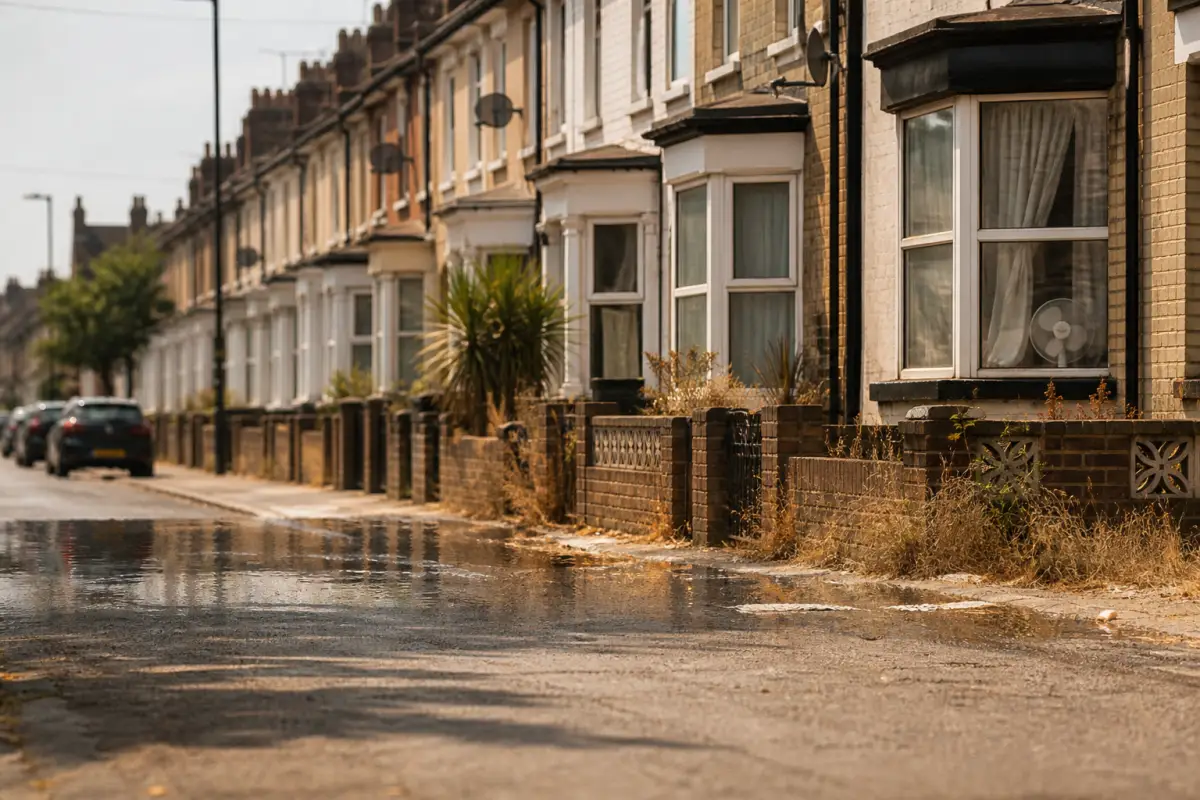
This summer was another hot one, and it followed a run of record-breaking years. That pattern is not a one-off. The Met Office and the government's climate advisers expect British summers to keep getting warmer, and they are now urging households to think about how their homes, and their bills, will cope.
What the projections say about a warmer UK
Projections are not fixed forecasts. They are scenarios that depend on how much greenhouse gas the world keeps emitting, so the range is wide by design.
The Met Office's UK Climate Projections show that, even on a low-emissions path, average annual temperatures could be around 2.3°C higher by the end of the century. On a high-emissions path, summers could be up to 5.4°C hotter, with milder, wetter winters alongside them. Hotter, drier summers and warmer, wetter winters are now the expected direction of travel. What remains open is how far it goes, and that hinges on the choices made over the coming decades.
Why adaptation has become the watchword
In its 2025 progress report to Parliament, the Climate Change Committee warned that heatwaves could pass 40°C across all parts of the UK by 2050, with the most extreme events higher still.
The 40°C reached in July 2022 was linked to around 3,000 excess deaths, a reminder that heat is a health risk and not just a question of comfort. The committee also found that the great majority of existing homes are prone to overheating in extreme heat.
Good to know: most UK homes were designed to hold heat in, not to keep it out, which is why adapting existing housing, and not just new-builds, is now the priority for coping with hotter summers.
The message is blunt: Britain now has to adapt its housing to summers it was never built for, rather than hope the hottest years stay rare.
What hotter summers mean for your energy bills
Warmer summers change how and when we use energy. Demand for cooling rises, whether through fans, portable units or fixed air conditioning, and it tends to peak on the hottest afternoons, exactly when the grid is most stretched.
The extra summer load creeps in from more than one place:
- Cooling appliances left running: a portable air-conditioning unit is one of the thirstiest things in the home, and a whole afternoon of it shows up on the bill.
- Fridges and freezers working harder: they draw more power when the room around them is hot, so a heatwave quietly lifts a cost you never switch on.
- Fans running overnight: cheap on their own, but they add up across a long, sticky spell.
Few UK homes have air conditioning, and those that do cool down often rely on fans or a portable unit rather than a fixed system, so the extra summer cost is usually modest. As a rough guide, a portable air-conditioning unit draws around 1.2 kW. Run it over the hot spells of a British summer, say around 20 days in all, and the seasonal cost works out as below (watts × hours × days ÷ 1,000 = kWh, then × the 26.11p Ofgem cap rate).
Even so, a portable unit run six hours a day across roughly three weeks of hot weather adds about 144 kWh, or close to £38 on the summer bill, and ownership is rising as heatwaves become more common.
Those figures are only a rough guide, but they show why it pays to know what a cooling appliance adds before you switch it on. Our guide to heatwaves explains how to stay comfortable without driving up your usage, and a few simple steps to cut your electricity use can offset some of the extra summer load.
How to prepare your home
Adapting a home need not mean installing air conditioning. Passive measures do much of the work, and most cost little or nothing:
- Close curtains and blinds by day: keeping the sun off south-facing windows stops rooms heating up in the first place.
- Open up at night: let the cooler evening air through to bring the temperature down for free.
- Improve insulation: it keeps heat out in summer and in during winter, so it cuts bills in both seasons.
- Do not run cooling with the windows open: you end up paying to cool the street.
- Do not set a portable unit colder than you need: every degree lower costs more to run.
Better energy efficiency helps in both seasons and keeps bills down at the same time. The government's Warm Homes Plan aims to upgrade millions of properties over the coming years, but households can start with low-cost changes today. The projections describe possibilities, not certainties. The sensible response is the same either way: prepare early, for the sake of comfort and cost alike.