
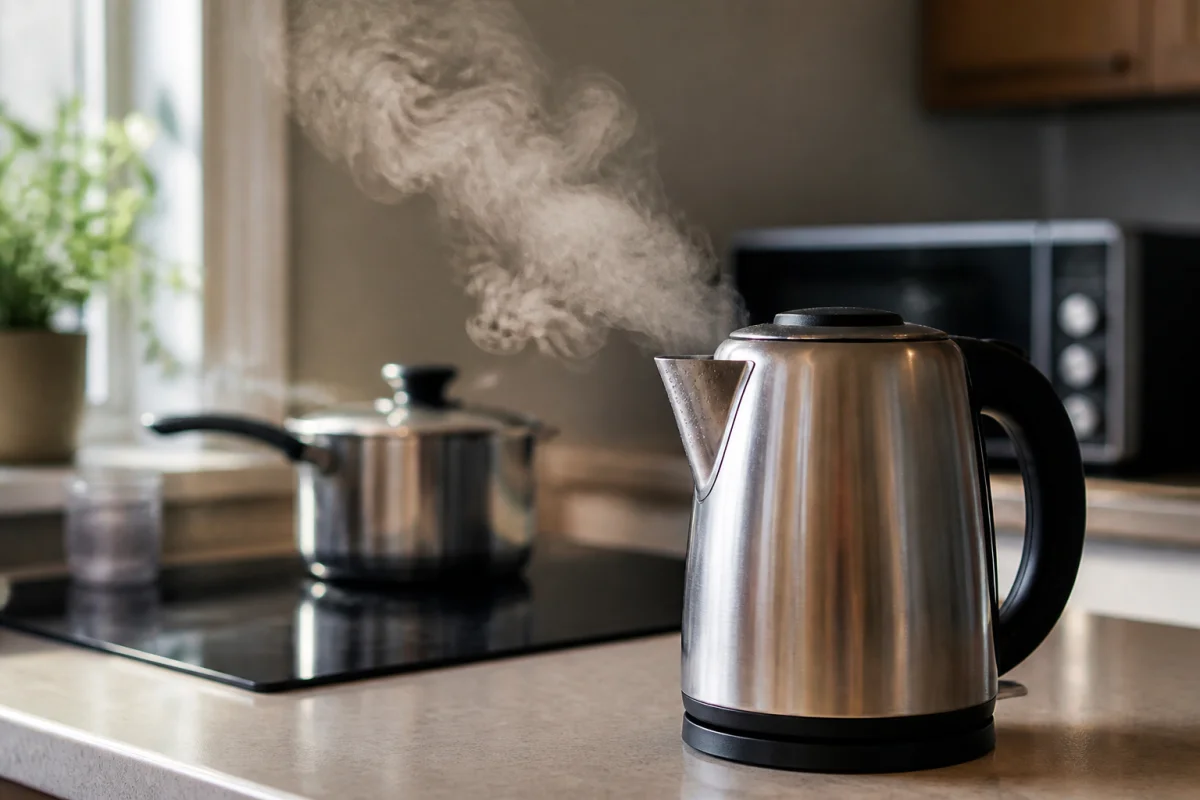
The kettle is arguably the most British appliance of all. There is one in almost every kitchen in the country, and most of us flick it on a dozen times a day without a second thought, for tea, coffee, pasta water or a hot water bottle. But is boiling the kettle really the cheapest way to heat water, or would the microwave or a pan on the hob do the job for less?
The honest answer is a little surprising. The appliance you choose matters far less than how you use it, and the real savings hide in two habits that cost nothing.
Heating a litre of water always needs the same energy
Heating one litre of water from cold tap temperature to boiling always needs roughly 0.093 kWh of energy, and no gadget can get below that figure. It is fixed by physics, not by marketing.
What changes between a kettle, a microwave and a pan is not the theoretical energy but the efficiency: how much of the electricity you pay for actually ends up in the water rather than escaping into the room as waste heat.
That is where the ranking is decided, and it is far less obvious than it looks.
The ranking, from kettle to gas hob
A kettle heats water from the inside, with the element sitting in the liquid and an insulated body holding the heat in. A microwave feels modern but loses a fair amount, while a pan depends entirely on the hob underneath it. Here is how the common methods line up, from most efficient to most wasteful.
- Electric kettle, around 90% efficient: almost all the energy reaches the water, and it is also the fastest way to boil a full litre.
- Induction hob, effectively level with it: it heats the base of the pan directly rather than the air around it, staying close to 90%.
- Ceramic electric hob, about 75%: some heat is lost between the plate and the base of the pan.
- Microwave, roughly 60 to 70%: fine for a mug, much weaker for a full litre, which it also struggles to bring to a true rolling boil.
- Gas hob, around 50%: the flame licks up the sides of the pan and much of the heat never reaches the water.
Gas is the great paradox of the kitchen: it wastes the most yet, costing so much less per unit than electricity, it can still work out cheapest per litre. Either way, putting a lid on the pan cuts the energy used by about a quarter. You will find more habits like this in our guide on how to save electricity.
What a litre of boiled water really costs
Put into pounds, at the current price cap of about 26.11p per kWh, the differences shrink until they are almost negligible for a single boil.
Over a year the gap stays modest. Someone boiling about a litre and a half of water a day spends a little over fourteen pounds a year with the kettle, against roughly nineteen with the microwave: barely four pounds between them. To see how these figures land on your bill, our guide to appliance running costs breaks it down by device.
Want the figure for your own kitchen? Enter how often you boil water each day and how much you heat:
The mistakes that cost ten times more than your choice of appliance
Here is the part that really matters. The most expensive habit is not picking the “wrong” appliance, it is filling the kettle to the top and boiling far more water than you need.
Boiling 1.7 litres for a single mug, three times a day, throws away about 164 kWh over a year, close to forty-three pounds. That is roughly ten times the four-pound gap between the kettle and the microwave. In other words, your habits overturn the appliance ranking completely.
Good to know: coffee and most teas are happier around 80°C. Reaching 80 rather than a full 100 uses roughly a quarter less energy, and it will not spoil the taste in the cup.
Two simple changes beat every efficiency table:
- Only boil the water you will actually use: most kettles have a minimum mark, so use it.
- Always put a lid on the pan when heating on the hob: a quarter of the energy saved for free.
- Stop at the temperature you need: 80°C for tea and coffee, a full boil only for pasta.
- Do not fill the kettle to the brim for a single mug: it is the most expensive waste of the year.
- Do not replace a working appliance to chase a few pounds of annual saving.
- Do not bring to the boil what does not need it, such as water for a herbal tea.
Is it worth switching appliances?
For anything more than a single mug, the electric kettle remains the sensible default: fast, efficient and cheap to run. The microwave is fine for one cup but loses its shine at volume, while a lidded pan on an efficient hob is closer than most people assume.
What you should not do is replace a working appliance to chase a few pounds a year: the saving never pays back the purchase.
- The bottom line
- For more than a single mug, the electric kettle is the cheapest and quickest choice.
- The microwave only wins for one cup; an induction hob is level with the kettle.
- A lid and the right temperature matter more than swapping appliances.
- The real waste is heating too much water: only boil what you need.
To place boiling water alongside the rest of your usage, it helps to know exactly what a kWh actually is and what it costs you.