
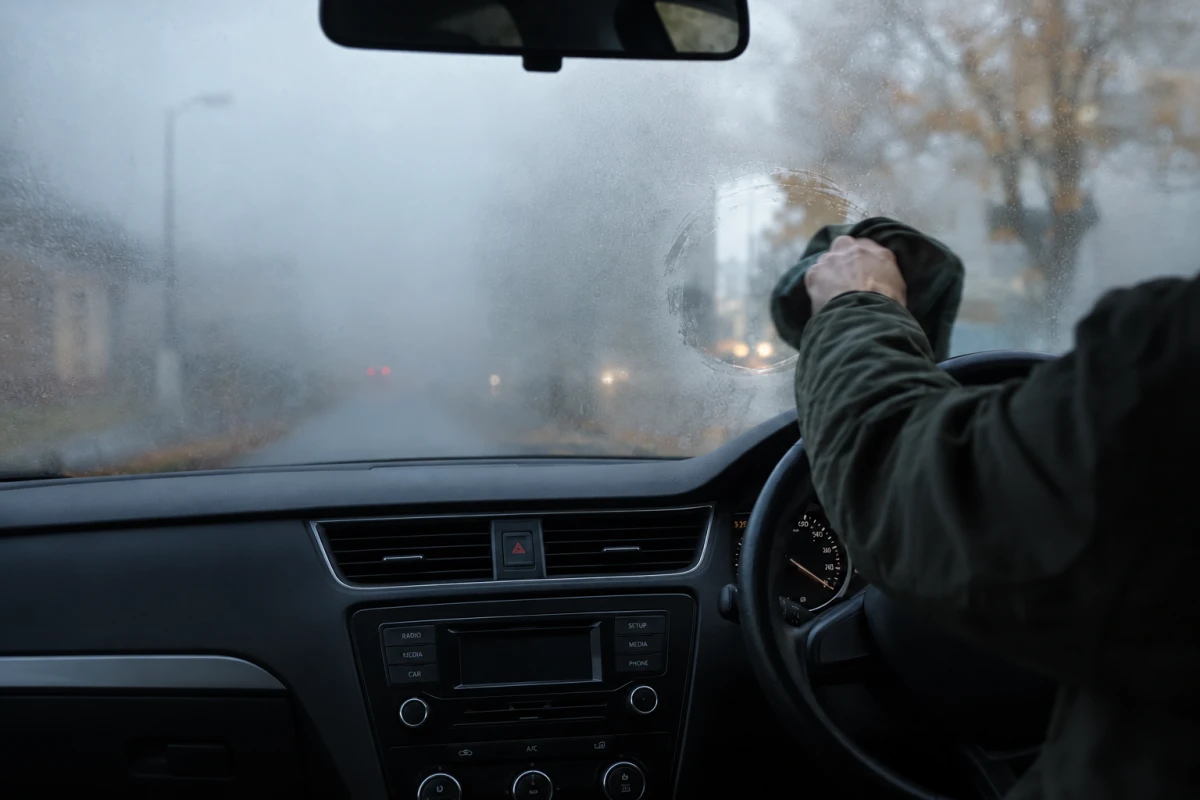
Seven forty-five, a cold car, three people with damp coats, and a windscreen that turns white the moment the doors close. You press the demist button, the fans roar, and within a minute or two the glass clears.
That button is doing more than blowing air at the screen. On a lot of cars it quietly starts something that runs off the engine and burns fuel. Knowing what it does, and in which order to set the controls, clears the glass faster and costs less.
Why the windscreen mists up on autumn mornings
The mist is water from inside the car: your breath, wet coats, damp floor mats. Overnight the glass has cooled, and when that moist air touches it, the vapour condenses into tiny droplets.
There are only two ways to get rid of it. Either you warm the glass, or you dry the air in the cabin, and the quickest results come from doing both.
Hot air is almost free once the engine is warm
In a petrol or diesel car, the heater recovers heat that the engine sheds into its coolant anyway. Once the engine is up to temperature, the only extra cost is the fan.
The catch is the first few minutes. A cold engine has no heat to give, so the vents blow cool air. Modern engines are also so efficient that they shed less heat, which is why many cars now carry electric heating elements to help out, and those do use fuel.
The consumption figures come from a 2016 review by the European Commission's Joint Research Centre (report EUR 27819), which pulled several studies together. On a car averaging around 51 mpg, a booster heater alone adds roughly 3 to 4.5% to fuel use while it runs.
Electric cars have no waste heat to recover, so every bit of warmth comes from the battery. A 2024 JRC study found that at −7°C, heating the cabin took the equivalent of 35 to 45% of the energy sent to the wheels over a test cycle.
Why the demist button costs fuel
Air conditioning is not only for summer. It passes the cabin air over a very cold coil where the moisture condenses and drains away, so the air comes out dry, and dry air clears mist faster than warm, damp air. On many recent cars, pressing the windscreen demist button switches the air conditioning on automatically, and often flips the air intake to outside air too. On a manual system you usually have to press A/C yourself.
The compressor is driven by the engine, so the extra cost depends above all on how long it runs. One study cited by the JRC puts it at about 4% extra in town, 2.5% on A roads and 1% on the motorway.
Around a dozen pounds over a winter on a typical commute, then, a little more on diesel, which costs more per litre at the pump. Our guide to petrol and diesel fuels covers the differences between the two. Not a reason to drive half blind, but a good reason not to leave A/C running all the way to work once the glass is clear.
A misted windscreen and the law
Rule 229 of the Highway Code says you must be able to see before you set off, and that windows should be thoroughly demisted. Under the Construction and Use Regulations, the glass must also be kept in a condition that does not obscure the driver's view.
Peering through a porthole wiped in the mist is exactly what an officer can stop you for. Clear the whole screen and the side windows before pulling away, not halfway down the road.
The settings that clear mist fastest
- Switch recirculation off and take air from outside. Recirculating keeps cycling the same damp air round the cabin.
- Direct the fan to the windscreen vents, strong enough to sweep the whole glass.
- Turn the air conditioning on for a few minutes to dry the air.
- Turn the temperature up as soon as the air comes out warm, which stops the mist coming straight back.
- Switch off A/C and the heated rear window once the glass is clear.
It is the reverse of summer, when recirculation helps the air conditioning cool the car. In autumn it traps the moisture inside.
- Clean the inside of the windscreen with a microfibre cloth and glass cleaner: a greasy film gives droplets something to cling to.
- Take wet coats and umbrellas out of the car overnight, and dry out soaked floor mats.