
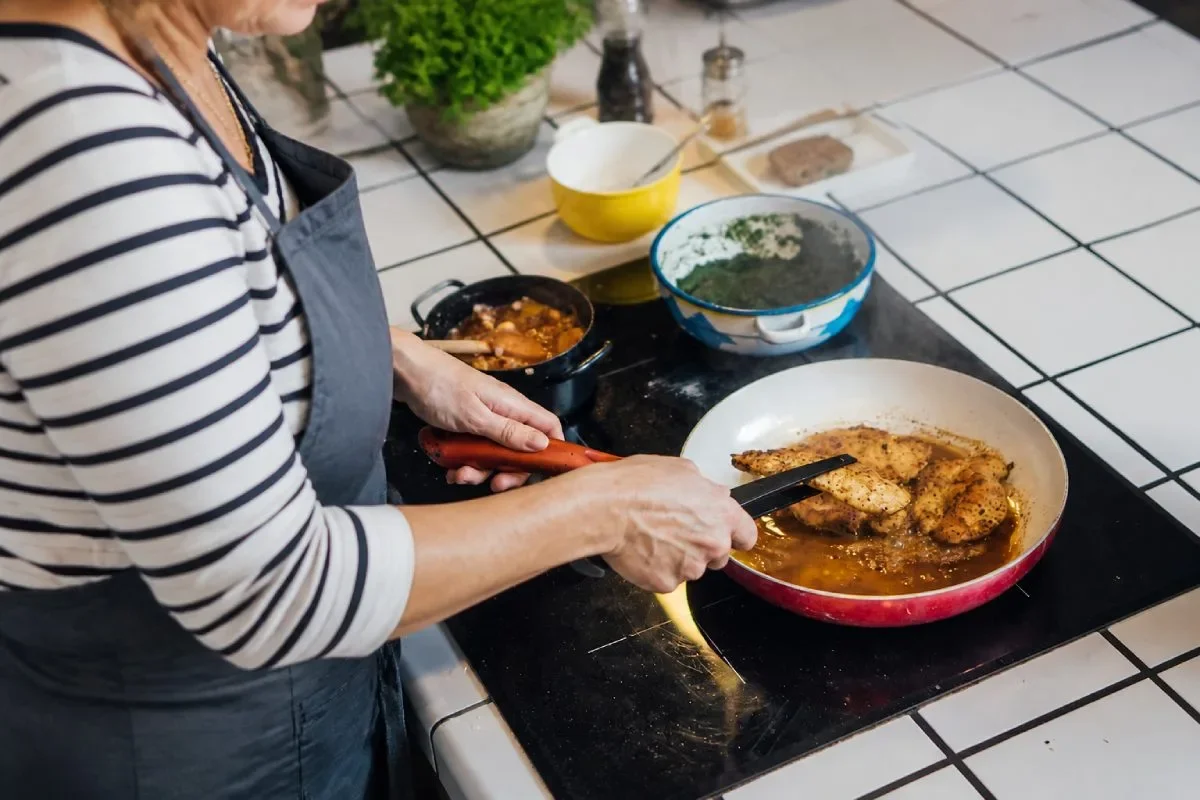
Anyone leaving hospital with a new pacemaker gets a leaflet listing what to keep away from the device. The induction hob is usually on it. The distance that comes with it is another matter: depending on whose advice you read, it can be 30 cm, 60 cm, a metre, or simply "avoid".
Those figures are not contradicting each other as much as they seem. They answer different questions, and the physics explains why.
No ban, and that is not an oversight
No UK rule stops a person with a pacemaker from cooking on induction. Whether a hob can disturb an implant depends on the device, how it is set and where it sits in the chest, so no single yes-or-no answer fits everyone.
Microwave ovens, often lumped in with induction, are not the issue. The British Heart Foundation states plainly that microwaves are safe to use with a pacemaker, and Medtronic lists them as no known risk.
Cardiologists do give a distance. Several, in fact
The figure you are most likely to meet in the UK is 60 cm, or two feet. It is what the British Heart Foundation recommends, what the Royal Brompton and Harefield hospitals print in their pacemaker leaflet, and what Medtronic, one of the main device makers, gives in its patient guide.
Elsewhere in Europe, patient leaflets range from 30 cm to a full metre. A hob maker has its own reasons to be cautious, and a hospital writing one leaflet for all its patients will pick a margin that covers the most sensitive device it fits.
So the useful question is not which number is right, but how close you have to be before the risk becomes real.
Why the numbers differ
An induction hob heats the pan through a magnetic field. On some models, power is regulated by switching on and off in pulses of around half a second, and the hob also pulses for roughly 15 seconds while it detects whether a pan is in place. Those slow rhythms sit close to a heartbeat, and that is the kind of signal an implant can struggle to filter out.
Researchers writing in the journal Europace measured the worst case. With a pan centred on the zone, the voltage induced in the pacemaker lead stayed under the 100 mV threshold that matters. With a large pan pushed off-centre, it reached 800 mV. Stepping back to 35 cm, about the length of a forearm, brought it back below 60 mV.
That worst case only happens when four conditions are met at once:
- A unipolar pacemaker implanted on the left, the configuration that picks up the most.
- Standing right up against the hob, chest leaning over the zone.
- A pan well off-centre, so the field spills towards the body.
- A device among the most sensitive tested, which was 14.8% of those in the study.
Most people with a modern pacemaker tick none or only some of those boxes, which is why the measured risk is far smaller than the strictest leaflets suggest. A device set to bipolar sensing is less sensitive still. A pacemaker on the right side is also outside the worst case studied.
What to do at the hob
There is a second, separate route for interference: a small current can pass through the body if you hold a metal pan or utensil for a long time while the zone is on. The practical rules cover both:
- Centre the pan on the zone, and use one that matches its size.
- Keep the 60 cm UK leaflets ask for, and never less than a forearm's length, the distance at which even the worst case measured fell back below the threshold.
- Do not rest a hand on the pan while it cooks, and stir with a wooden spoon, whichever side your device is on.
- Ask your pacing clinic, which knows your exact model and how it is programmed.
The clinic's answer is the one that counts, since it is the only one written for your device. If you have an implantable defibrillator rather than a pacemaker, the studies above do not cover it, so ask there too.
Once that question is settled, the choice between induction, ceramic and gas comes down to the usual things: price, cooking style and running costs. Our guide to appliance running costs compares what the kitchen uses, and the electricity it draws costs 26.32p per kWh under the price cap from 1 October.