
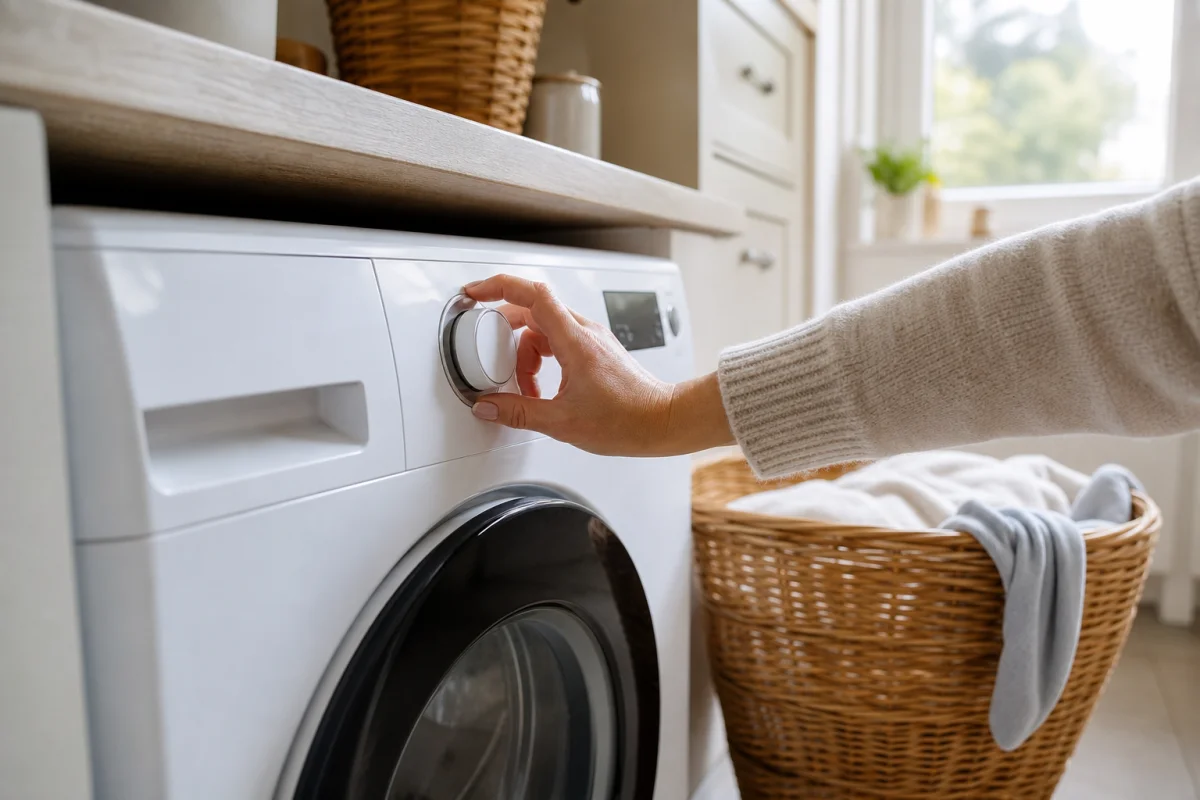
The whole trick is a quarter-turn of a dial. Dropping your washing machine from 60°C to 30°C takes an immediate slice off your electricity bill, and the reason is simple: most of the energy in a wash cycle goes into heating the water, not turning the drum. In summer, when laundry is frequent and rarely very dirty, the saving stacks up load after load.
Heating the water: the real cost
In a typical cycle, around 80% of the energy is spent heating the water. The drum's movement barely registers. That one detail explains everything: lowering the wash temperature cuts electricity consumption directly. Switching from 60°C to 30°C roughly halves the energy used per cycle; compared with a 90°C wash, a 30°C cycle uses about three times less.
The part that surprises most people: the vast majority of household laundry washes perfectly well at 30°C, with no visible difference in cleanliness. Low-temperature washing suits lightly soiled clothes worn for a single day — which is most of the summer basket. Modern detergents are formulated precisely to work in cool water.
What you save over a year
An average household runs about four washes a week — over 200 cycles a year. At that pace, the gap between 30°C and 60°C adds up to real money. A 60°C cycle draws around 1.3 kWh; a 30°C cycle roughly half that: 0.65 kWh saved on every load.
At the current price cap unit rate of 26.11p per kWh, every load moved down to 30°C saves about 17p. That sounds small — but across 200-plus cycles a year it comes to roughly 135 kWh, or about £35, for a change that costs nothing and requires no new kit.
Efficiency studies confirm the order of magnitude: washing at 30°C uses three times less energy than at 90°C and half as much as at 60°C. As for the machine itself: a 7kg class D model running 208 times a year draws about 133 kWh, while a recent, efficient 8kg machine comes in nearer 85 kWh. The exact numbers shift with the size and rating of the appliance, but the logic never does: every cycle moved down to 30°C costs roughly half.
One often-forgotten detail completes the sums: a washing machine also uses water — around 50 litres per cycle — and on a water meter, wasted half-loads are paid for twice. A full drum and a low temperature act on both lines of the bill at once.
Two summer habits that multiply the gain
First: fill the drum properly. Two half-loads use more energy than one full one, even with a half-load setting. Summer clothes are light, so the drum fills fast and every cycle runs at maximum efficiency.
Second: forget the tumble dryer while the sun is doing the job for free. The dryer is one of the hungriest appliances in the house; in July and August, a clothes airer or washing line does the same work at zero cost, in a couple of hours. A summer of line-drying is often worth more than the cool-wash saving itself.
Worth remembering: 80% of a cycle's energy heats the water; at 30°C consumption halves; on four loads a week, that quarter-turn of the dial is worth around £35 a year. And the washing machine is just one line on the bill — knowing your unit rate is still the quickest way to understand where your money actually goes.
When 60°C genuinely matters
High temperatures still earn their keep in three specific cases: bedding and towels when someone in the house is ill, items in contact with very sensitive or allergy-prone skin where dust mites are a concern, and the monthly maintenance wash of the machine itself, run empty, to prevent odours and detergent build-up in the drum. For everything else, the dial can stay left — and you'll see the difference at the end of the year on your bill, not on your clothes.