
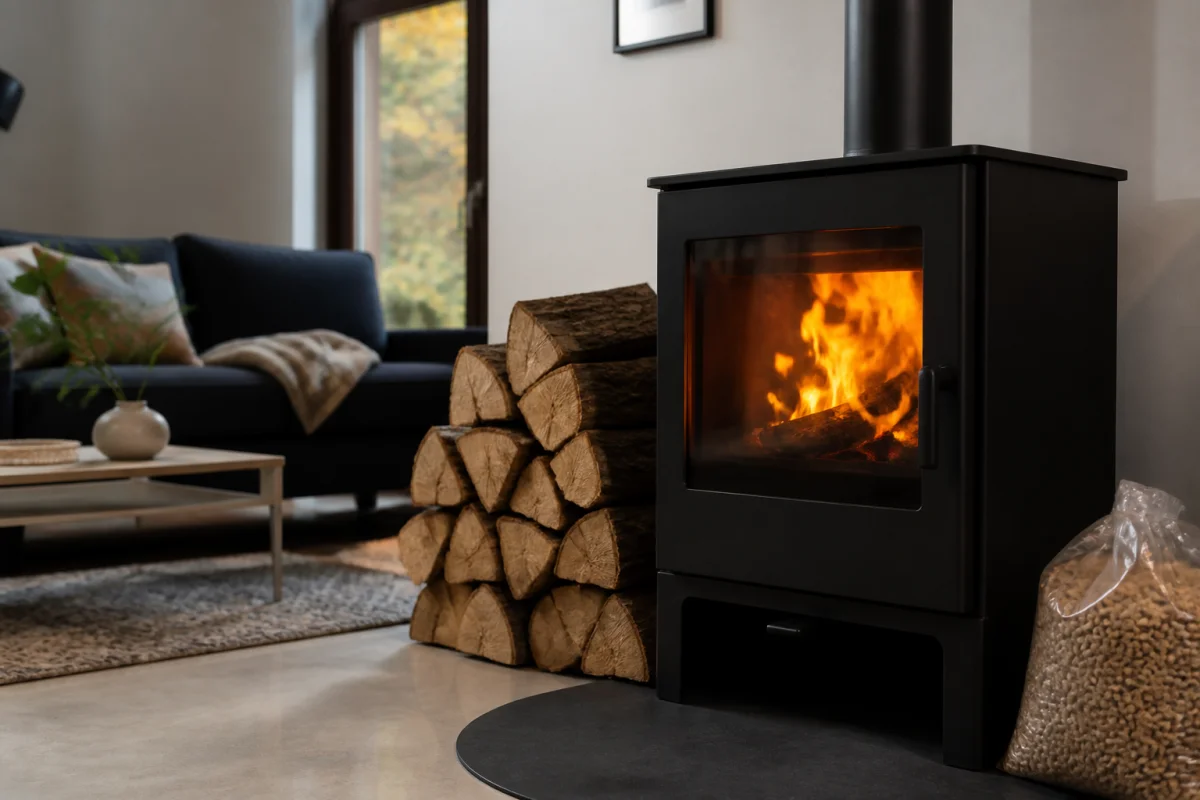
As the first cold snaps arrive and heating creeps back up the household budget, more people across Britain are looking again at solid-fuel heating. The choice usually comes down to two appliances: the familiar wood-burning stove, or the more automated pellet stove. Both put out plenty of heat, but in the UK the decision is shaped as much by regulation as by running cost, and it pays to weigh up both before the season sets in.
Running costs are closer than many households expect
Firewood is not automatically the cheaper option in Britain. Kiln-dried hardwood logs, the sensible choice for a modern stove, typically cost between £250 and £500 per tonne, with bulk bags from around £115. Wood pellets sit in a similar band, roughly £250 to £360 per tonne for blown deliveries, or about £5.83 for a 15kg bag. Because the fuel prices overlap so much, the deciding factor is usually efficiency rather than the price on the label.
Here the pellet stove has the edge. Modern log burners run at around 75 to 80% efficiency, while pellet appliances frequently top 90%, so more of the fuel you pay for ends up as heat in the room. In practice the pellet stove's higher efficiency often makes it the cheaper option per unit of heat, at roughly 7 to 8p per kWh against 10 to 11p for logs. Both, though, undercut electric heating by a wide margin, with the Ofgem price cap electricity rate sitting near 27p per kWh this year.
The rules matter as much as the price
Regulation is where the British picture differs most from the Continent. Since 1 January 2022, every new wood-burning or multi-fuel stove sold in Great Britain must meet Ecodesign standards, which set a minimum thermal efficiency and tight limits on particulate emissions. The headline rumour is worth putting to bed: wood burners are not banned in 2026, but the appliance and the fuel are more tightly controlled than ever.
Three rules do most of the work, and each is easy to check before you buy:
- Ecodesign compliance: any new stove must meet a minimum thermal efficiency of 65% and emission caps.
- DEFRA exemption in a Smoke Control Area: you need a DEFRA-exempt appliance, which is not the same approval as Ecodesign-ready.
- Ready to Burn fuel: logs sold in small volumes must carry the logo, confirming moisture below 20%.
A cleaner-burning, correctly fuelled stove also lifts your home's overall energy efficiency, which keeps the running cost down season after season.
Good to know: roughly one in five British homes sits in a Smoke Control Area. Check your postcode with your local council before buying, because there an ordinary Ecodesign stove is not enough and you must fit a DEFRA-exempt model.
Autonomy on one side, availability on the other
On convenience, the pellet stove is hard to beat. It offers an autonomy of one to five days depending on hopper size, with programmable ignition, automatic feeding and a steady temperature that needs little attention.
The trade-off is that it relies on mains electricity, needs dry storage and, importantly, remains a niche product in Britain, where log burners still dominate the market. That makes appliances, spare parts, servicing and local fuel supply all easier to find for wood. A wood-burning stove asks for more effort, loading logs and tending the flame, but it runs silently, works in a power cut and stores easily if you have the space.
- Pick a pellet stove for automation, programmable heat and the highest efficiency.
- Pick a pellet stove if you want a steady, hands-off temperature all day.
- Think twice on pellets if your area has a thin supply network or few local installers.
- Think twice on pellets if power cuts are common where you live, as the stove needs the mains.
A pellet stove rewards convenience, a log burner rewards supply
There is no single right answer. A wood-burning stove suits households with room to store and season logs, a reliable local supplier and no objection to tending a fire by hand. A pellet stove appeals to those who value automation, programmable heat and high efficiency, and who do not mind depending on the mains and a narrower supply network.
Whichever way you lean, a few checks make the difference between a good buy and an expensive mistake. Set the running cost against your other household appliances so you can see where the stove really sits in your budget.
- Before you buy, this winter
- Confirm your Smoke Control status with the council, and fit a DEFRA-exempt stove if you need one.
- Match the fuel to your supply: choose logs where wood is cheap and local, pellets where you want automation.
- Compare the cost of heat, not the price of fuel, because efficiency is what decides the yearly bill.