
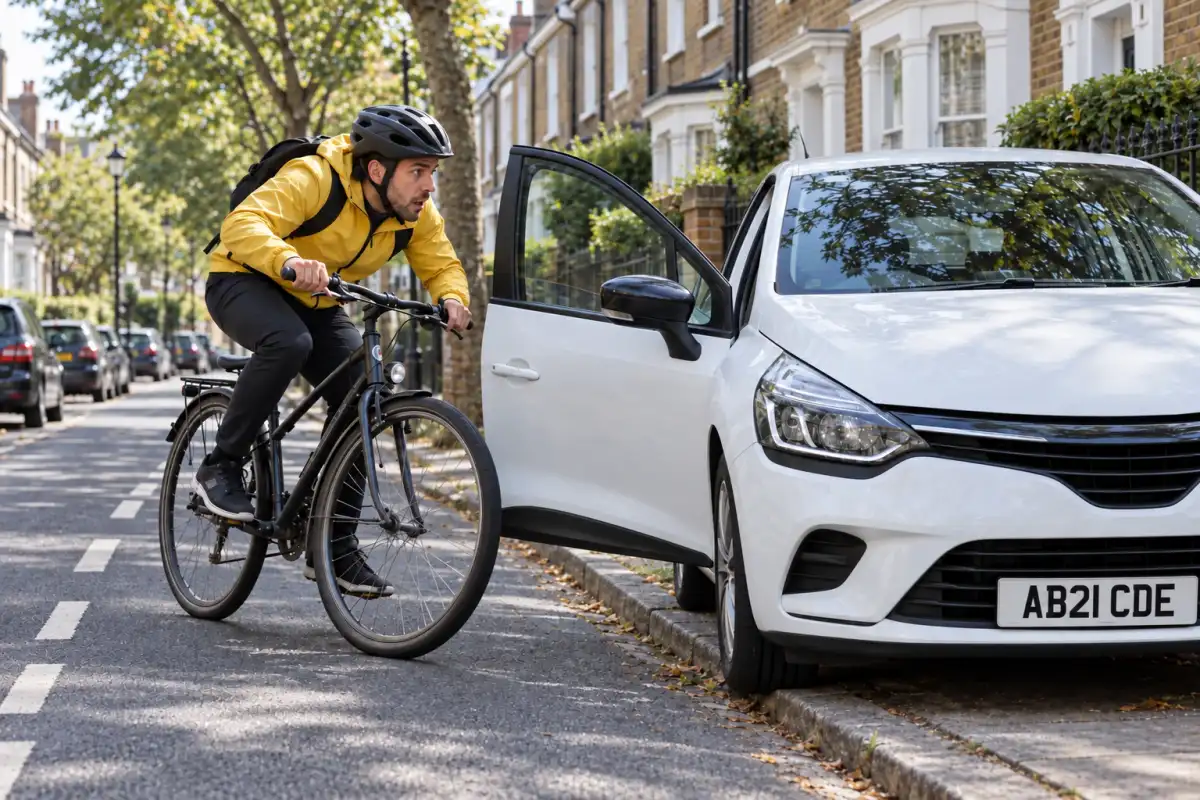
A car is parked, a door swings open without a glance in the mirror, and the cyclist coming past has nowhere to go. Within seconds there is a broken wrist, a buckled front wheel and three people all wondering whose fault it is.
Who opened the door, the driver or a passenger, matters less than most people think. What matters is which insurance policy answers, and how the blame is shared once the injuries and the bike are counted.
Opening a door carelessly is a criminal offence, for anyone in the car
Regulation 105 of the Road Vehicles (Construction and Use) Regulations 1986 makes it an offence to open a vehicle door on a road so as to injure or endanger anyone. It applies to whoever opens the door, driver or passenger, front or back, and it can mean a fine of up to £1,000 in court.
That fine is personal. No insurer pays it, and it is separate from the question of compensating the cyclist.
Three common beliefs do not survive the rules:
- "The car was parked, so it doesn't count": the offence and the motor insurance both apply to a stationary car.
- "Only the driver can be blamed": a passenger who opens the door commits the same offence.
- "The insurer will pay the fine": a criminal fine is never covered by insurance.
The Highway Code has also spelled out the safe habit since 2022. Rule 239 recommends the "Dutch reach": opening the door with the hand furthest from it, which turns your body and makes you look over your shoulder before the door moves.
Even parked, the car's insurance is the one that pays the cyclist
A UK motor policy does not only cover the driver at the wheel. Policies routinely extend third-party cover to anyone travelling in the car or getting in or out of it, and a parked car with its door opening is still being used on the road.
So the cyclist claims against the car's insurer, for injuries, lost earnings and damaged property. If the car turns out to be uninsured or drives off and cannot be traced, the Motor Insurers' Bureau steps in. A passenger getting out of a taxi or a private hire car is covered by that vehicle's own business policy.
A few details make the claim far easier later on:
- The registration number and the name of the person who opened the door.
- The driver's insurer: drivers must give their details after an injury collision, and the police must be told if they do not.
- Photos of the door, the bike and the spot, plus witnesses' contact details.
- Medical records from the same day, even for injuries that seem minor.
Driver or passenger, it is still the car's policy that answers
The driver cannot shift the problem onto a passenger by saying "it wasn't me". The insurer pays on behalf of whichever occupant opened the door, because that occupant is insured under the same policy.
Cyclists also sit outside the 2021 whiplash reforms. Their injury claims do not go through the Official Injury Claim portal for car occupants, and the general three-year limit for personal injury claims applies.
Broken bike, dented door, no-claims: where each person's fault comes in
UK compensation is fault-based. A cyclist hit by a door opened without looking is very rarely to blame, but contributory negligence can reduce a payout. Rule 67 of the Highway Code tells cyclists to leave plenty of room when passing parked cars and to watch for doors, so riding tight along a row of parked cars can be raised against you.
Take Sam, 34, a nurse in Bristol, doored by a rear passenger getting out of a parked car. Sam breaks a wrist, misses six weeks of work and writes off £680 of bike and helmet, plus a pair of glasses. All of it is claimed from the car's insurer. For the car's owner, the payout usually counts as a fault claim, which in market practice steps the no-claims discount back by two years, as our no-claims bonus guide explains, even though the owner never touched the door.
The reverse case is rare but real. A cyclist found at fault for damaging a car may be covered by the personal liability section of a contents insurance policy, or by the third-party cover that comes with membership of some cycling organisations. Check both before you ride.