
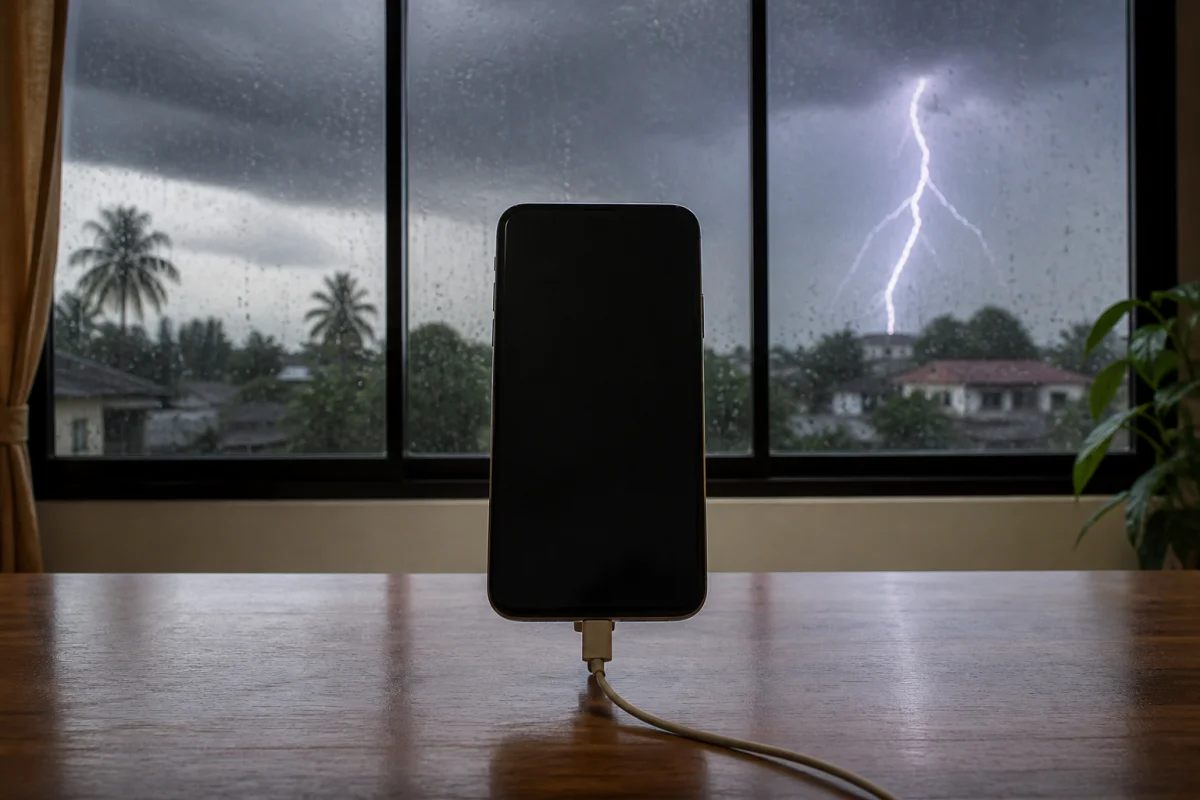
A crack of thunder, a bright flash at the window, and the phone suddenly feels like the last thing you should be holding. It is a common worry, and a reasonable one to check. The good news is that the popular fear is largely misplaced. Whether your mobile is safe during a storm comes down to one simple question: is it plugged into the mains or not? Once you understand why that single detail matters, the sensible precautions almost pick themselves.
A phone on battery is not the problem
A mobile running on its own battery has no wired connection to the outside world. Lightning is an enormous electrical surge that needs a physical path to travel along, typically your home's wiring, plumbing or an aerial. A handset sitting in your palm offers no such route, so a nearby strike has nothing to follow into the device.
Using a phone that is not plugged in carries no meaningful lightning risk, because there is no wired path for a surge to reach it. The idea that a switched-on mobile somehow draws lightning towards you is a myth. Phones do not attract strikes; their signals are far too weak to influence where lightning goes.
The real risk is a phone on charge
The picture changes the moment you connect to the mains. A phone plugged into a wall socket becomes part of your home's electrical system, and that system is exactly what a surge can travel through. If lightning strikes a power line or the ground nearby, the resulting spike can race along the wiring and reach anything connected to it.
In that scenario the charger, the cable and the phone at the end of it are all exposed. The damage is usually done to the charging circuitry or the battery, and in a bad case the handset can be ruined outright. The safest move during an active storm is simply to unplug the charger and let the phone run on its battery until things pass.
Surge protection helps, but it has limits
If you would rather not unplug everything every time the sky darkens, a surge-protected socket or extension lead offers a layer of defence. These devices are designed to absorb or divert smaller voltage spikes before they reach whatever is connected, which is worthwhile for chargers, laptops, routers and televisions alike.
A surge protector is genuinely useful against the everyday spikes that storms produce, but it is not a guarantee against a direct or very close strike. A powerful enough surge can overwhelm the protection entirely. Treat these sockets as insurance that reduces the odds, not as permission to leave sensitive kit plugged in through the worst of the weather.
Simple habits to keep during a storm
None of this calls for panic. A few small habits cover the realistic risks and let you carry on using your phone with confidence while the weather does its worst.
- Unplug the charger and use the phone on battery until the storm has clearly passed.
- Do the same for other valuable devices, or at least route them through a surge-protected socket.
- Avoid charging right next to a window during severe storms, where wiring and aerials tend to run.
- Charge fully before the weather turns, so a long spell on battery is never a worry.
- Ignore the old myth: a phone in your hand does not attract lightning.
Running on battery for an hour or two is easy to manage, and if you are watching for updates or staying in touch it helps to keep an eye on consumption. A quick read of our tips for using less mobile data can stretch a charge further when you would rather leave everything unplugged. That way the storm passes, your phone stays useful, and nothing important is sitting on the mains waiting for a surge.