
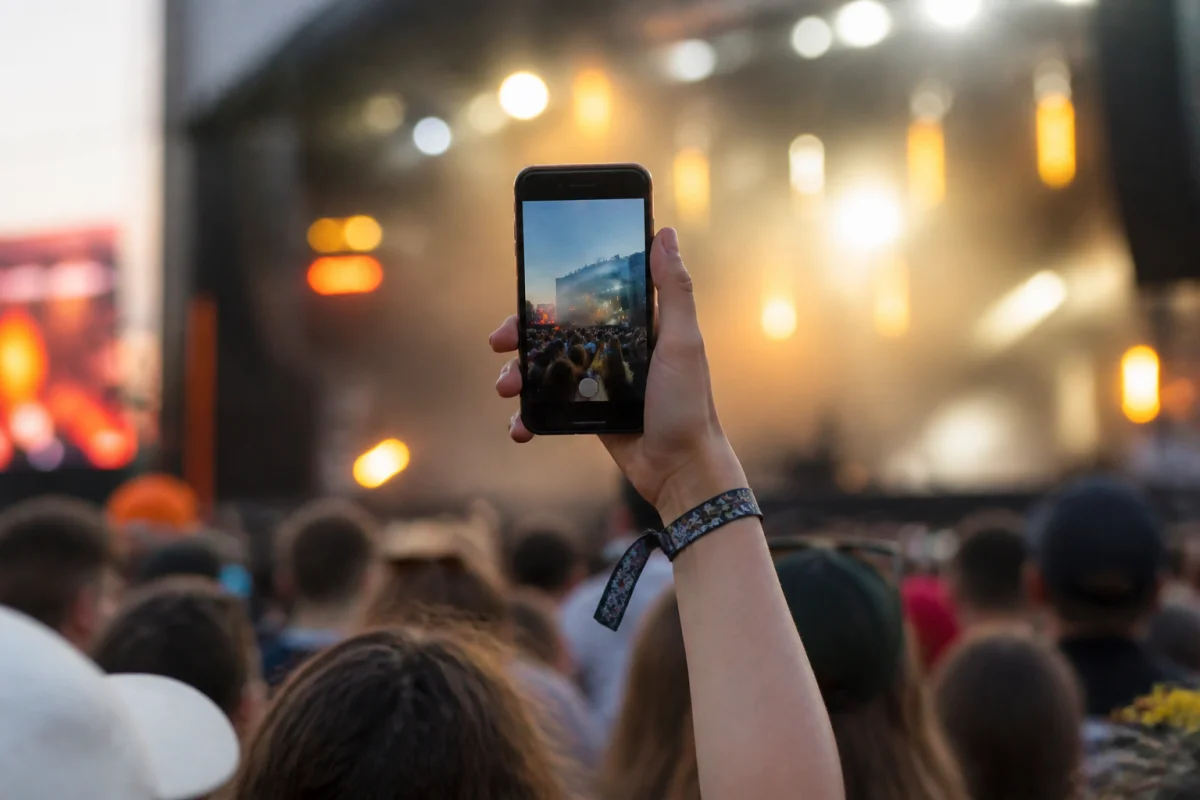
You are at a festival, a fireworks display or a sold-out match. The signal icon shows full bars, maybe even a reassuring 5G symbol, and yet the page will not load, the photo will not upload, and the text to your friends sits there refusing to send. It is one of the most frustrating experiences in modern life, precisely because everything looks like it should be working. The good news is that this is rarely a fault with your phone or a gap in coverage. It is a predictable side effect of thousands of people standing in the same field, and once you understand it, you can work around it.
Why the network jams in a crowd
Every mobile mast, or cell, can only handle a set number of active connections at once. Coverage tells you whether a signal reaches you at all; capacity tells you how many people that signal can serve at the same time. On an ordinary day the two rarely collide, because the crowd is spread thinly across many cells. Pack tens of thousands of people into a single field, and one or two masts suddenly have to serve everyone at once.
The problem is not that the signal is weak, it is that the cell simply runs out of room to carry everyone's data at the same time. That is why coverage maps can look perfect for an area that turns into a dead zone the moment a big event fills it up.
Full bars but no internet
This is the part that confuses people most. The bars measure signal strength, in other words how clearly your phone can hear the mast. They say nothing about whether there is any spare capacity once you connect. So you can have a strong, clear line to a mast that is completely overloaded, and the result is full bars with no usable internet.
Even a fast connection behaves this way when the cell is saturated. If you want the technical background on the technology that is meant to handle busy areas, our plain-English guide to how 5G works explains why extra speed does not always mean extra room. When demand outstrips capacity, everyone shares what little is left, and data slows to a crawl for the whole crowd.
Tricks to stay in touch anyway
When data grinds to a halt, the trick is to fall back on the lightest possible ways of communicating. A short text message needs a tiny fraction of the network's resources and often slips through when nothing else will. Here are the habits that make the biggest difference:
- Send a plain SMS or text message rather than relying on apps that need data.
- Avoid uploading videos and high-resolution photos until you are somewhere quieter.
- Turn on Wi-Fi calling if your phone and network support it, and connect to any reliable Wi-Fi on site.
- Step towards the edges of the crowd, where fewer people are competing for the same cell.
- Keep messages short and resend once rather than firing off several attempts, which only adds to the congestion.
Plan ahead before the event
The most effective fix happens before you arrive, when you still have a working connection. Assume that data will be patchy and prepare as if you will have almost none. A few minutes of planning saves a great deal of stress later.
- Agree a clear meeting point with your group, plus a backup spot and a time to regroup.
- Download tickets, maps and travel details in advance so they work offline.
- Share your live location before you lose signal, and let people know it may freeze.
- Set a simple rule, such as texting rather than calling, so everyone falls back on the same method.
Deciding where and when to meet before the crowd swallows your connection is the single most reliable way to find your friends again. When the network is straining under thousands of people, a plan you made earlier will always beat a message that never sends.