
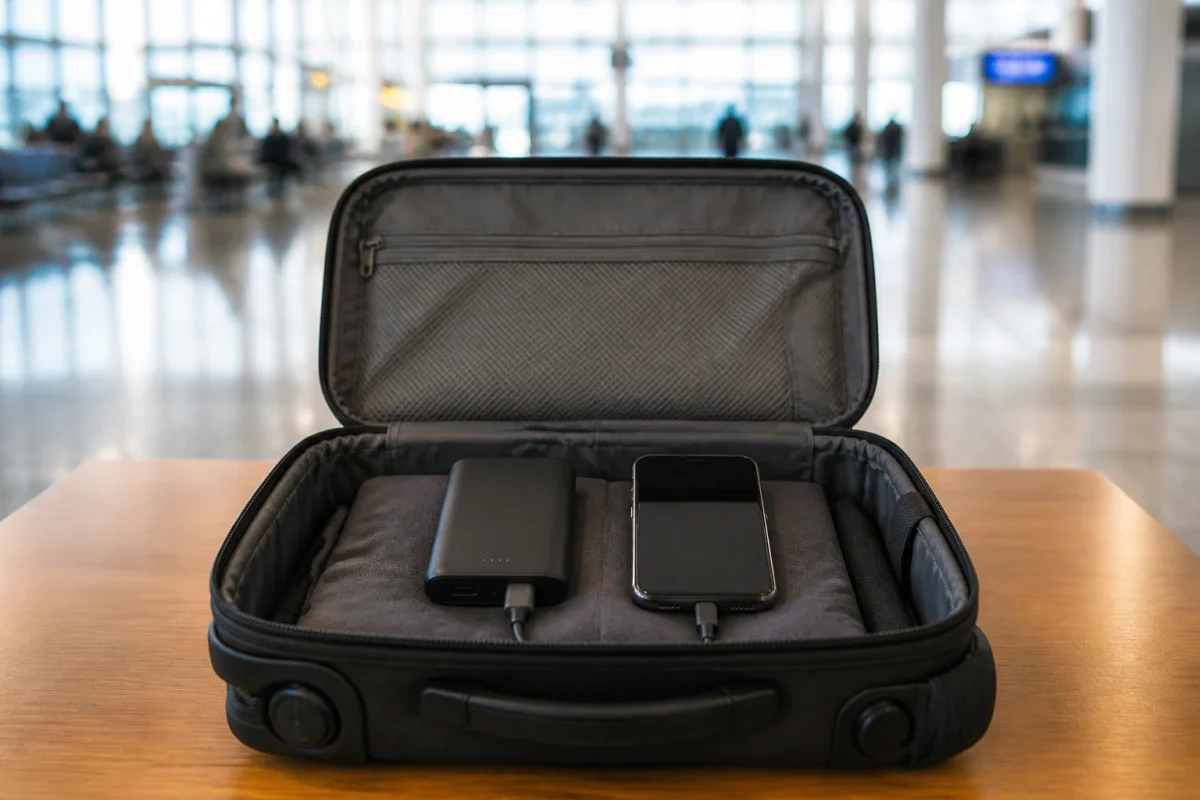
Few things are more useful on a long day of travelling than a fully charged phone, and few things get pulled aside at security more often than the power bank that keeps it topped up. The rules are not complicated, but they are strict, and airline staff apply them closely because a lithium battery packed in the wrong place is treated as a genuine safety risk. Knowing where your power bank belongs and how much charge it is allowed to hold will save you an awkward conversation at the scanner and, in the worst case, a confiscated device.
Why a power bank must travel in your cabin bag
Lithium batteries can, very rarely, overheat and catch fire. If that happens in the cabin, the crew can see it and deal with it immediately. In the hold, out of reach and out of sight, a fire would be far harder to control. For that reason power banks and spare lithium batteries must always go in your hand luggage and never in a checked suitcase.
Many airlines have gone a step further in recent months. It is now common to be asked not to use or charge a power bank during the flight, and to keep it somewhere you can reach it quickly rather than buried in an overhead locker.
The watt-hour limits explained
Airlines measure a battery's capacity in watt-hours (Wh), not the milliamp-hours (mAh) printed on the side of most power banks. The thresholds are broadly consistent across carriers:
- Up to 100Wh: generally allowed with no special permission.
- Between 100Wh and 160Wh: usually permitted, but you need the airline's approval and are limited to a small number of units, often two.
- Above 160Wh: not allowed in the cabin at all.
The good news is that almost every power bank sold for charging a phone sits comfortably under the 100Wh line, so the vast majority of travellers never approach the limit.
How to check your power bank's capacity
If your device only shows a figure in mAh, the conversion is straightforward. Multiply the milliamp-hours by the voltage, then divide by 1,000 to get watt-hours: mAh multiplied by volts, divided by 1,000, gives you the watt-hour figure the airline actually cares about. Most power banks run at 3.7V.
To put that in context, a typical 20,000mAh bank works out at roughly 74Wh, well within the standard allowance. As a rough guide:
- Find the mAh rating and the voltage, both usually printed near the ports or on the underside.
- Multiply them together, then divide by 1,000.
- Compare the result against the 100Wh and 160Wh thresholds above.
The same thinking applies to the other kit that keeps you connected on the move, from a spare laptop battery to the phone itself. If you rely on a local data plan abroad, an eSIM you can activate before you fly means one less physical item to worry about at the security tray.
What to do at security
A little preparation goes a long way. Keep power banks in your hand luggage, ideally somewhere near the top so you can present them if asked, and be ready to explain the capacity if a member of staff queries it. A device with a battery you cannot identify may be held back, so a clearly labelled power bank always moves faster.
Above all, check your specific airline's policy before you leave home. Carriers differ on the finer points, particularly around using or charging a power bank in flight and how many higher-capacity units they will accept, and the rules have been tightening. A two-minute look at the airline's website is the surest way to reach the gate without a hitch.