
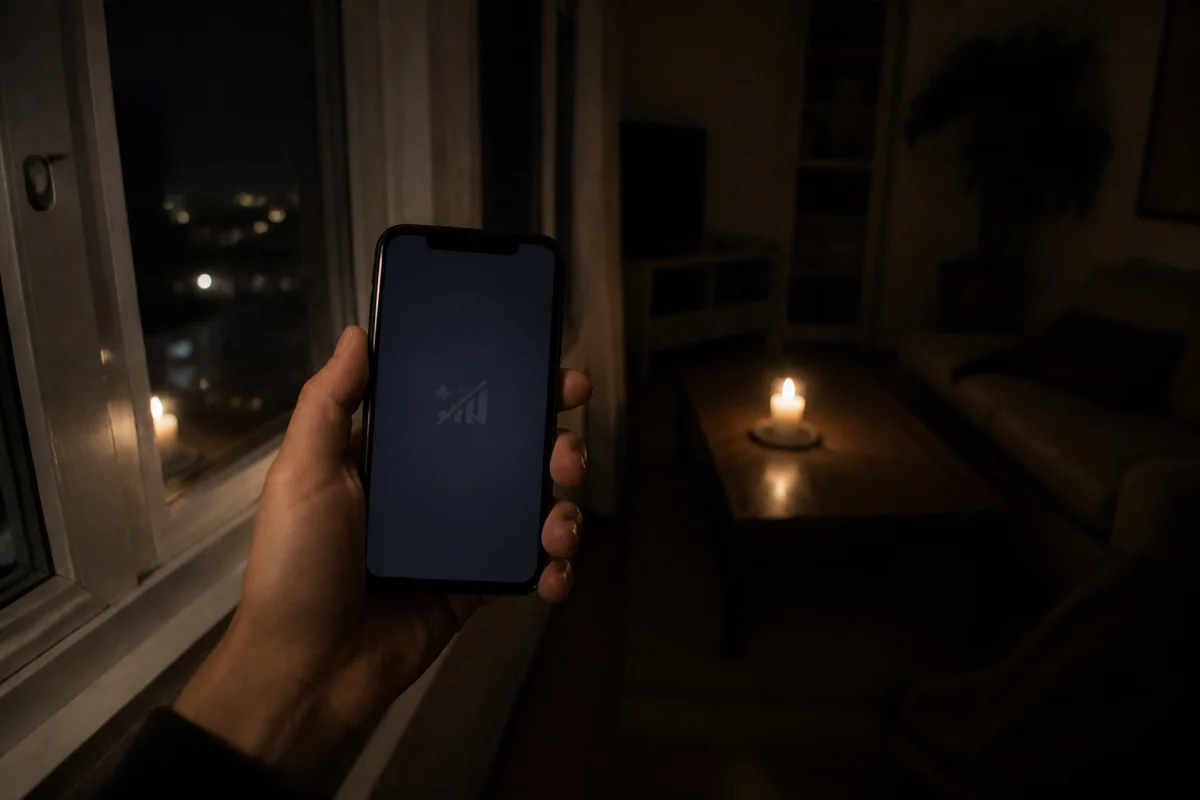
Picture a winter storm that knocks out the power across your street. Your phone is fully charged, yet within minutes the bars vanish and your calls will not connect. The handset is not the problem. When the mains goes down, the masts that carry your signal are living on borrowed time, and it is often a matter of minutes rather than hours.
The masts run on batteries for minutes, not hours
The moment the power fails, your home broadband router dies, and with it go the wi-fi, the landline and the cordless phone. Mobile masts are built to cope a little better, because many carry backup batteries that kick in on their own. The catch is how long they last.
The time a mast can run on battery is measured in minutes, not hours. Ofcom reckons only about a fifth of mast sites keep working for at least an hour, and plenty run flat well before that. Once the battery is gone, there are no calls, texts or data in that area, even when the phone in your pocket is still fully charged.
When the power comes back, most sites restart on their own, though some need an engineer to visit before the signal returns. That is why coverage tends to come back patchily, street by street, after a widespread outage. If you want to know how your area holds up, it is worth learning how to check the coverage on your network before bad weather arrives, because the culprit is almost always the mast, not your handset.
Why fibre does not save you like the old copper line
Not so long ago, the home phone worked even in a blackout. The old copper line drew its power from the exchange, down the wire itself, so it kept going regardless of the mains. All you needed was a corded handset.
Digital Voice and full-fibre lines have quietly removed that safety net: everything now hangs on a plug socket at home. Providers must offer a battery backup unit to customers who rely on their landline, but take-up is patchy. For most households the mobile is now the only lifeline, and it is the one with a battery clock ticking on the nearest mast.
How to stay reachable when everything goes dark
The trick is to get ready before you need to. A little forward planning beats any clever trick improvised in the dark.
- Charge your phone and a power bank when a weather warning is issued, so you start the outage with a full tank of energy.
- Keep a battery or wind-up radio to hand for updates once the internet goes too.
- Save the key numbers and family contacts offline, rather than relying on the cloud.
- Do not leave the phone hunting for signal for hours: it drains the battery to no purpose exactly when you need it most.
- Do not burn the charge on video and streaming during the emergency.
- Do not wait for the storm to find out where you get signal at home.
During the outage itself, a few moves in the right order stretch the time you have:
- Switch on aeroplane mode when there is no signal, and turn it off every half hour to test the network.
- Send a text rather than call: it uses far less of the network and stands a better chance of getting through when a mast is under strain.
- Turn the brightness down and close background apps so the phone can use less data and hold its charge longer.
- Set an emergency contact that is reachable from the lock screen, so anyone can reach your family.
A 999 call can get through even when your network is silent
Good to know: a call to 999 or 112 can connect through any operator's mast that still has power, not only your own network. So if your provider is dead but a rival mast nearby is holding on, the call still has a chance of going out.
That is why, in a real emergency, it is always worth trying 999 even when the screen says no service. It also helps to carry a phone that can go longer between charges, so the handset is not the first thing to give up.
Spain now demands four hours. What about Britain?
The question landed on regulators' desks across Europe after the huge blackout that left Spain and Portugal in the dark in April 2025. Madrid responded with a rule requiring operators to keep mobile networks running for at least four hours in a blackout, with the cost of the backup falling on the companies.
Britain is not there yet. Ofcom's revised resilience guidance, updated in June 2026, sets expectations on backup power but stops short of a fixed number of hours. It has estimated that making sure almost everyone could reach the emergency services for up to four hours would cost around £1bn, and the operators have pushed back hard. With 999 outages already making headlines, and roughly 42 million emergency calls a year now coming mostly from mobiles, the gap between a few minutes of backup and the length of a real crisis is hard to ignore.