
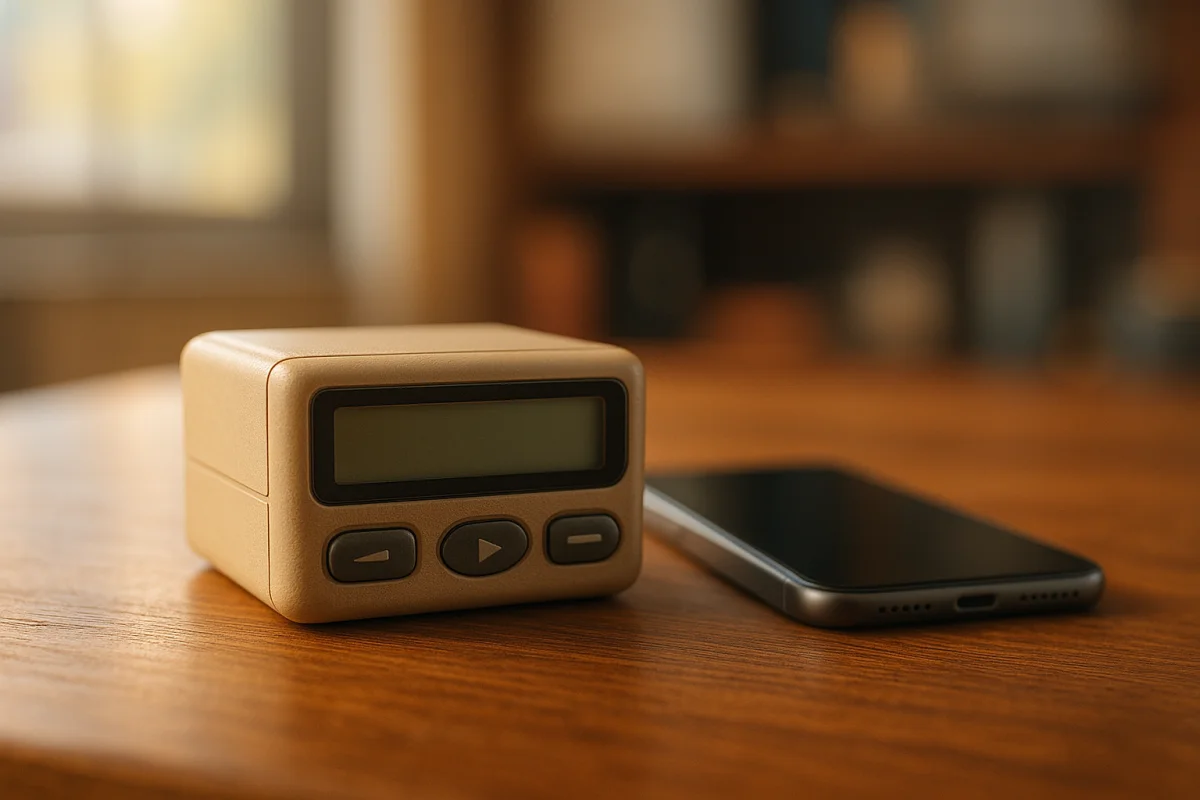
It was meant to vanish years ago, killed off by the smartphone in everyone's pocket. Yet the pager is still buzzing on hospital wards across Britain, on building sites and in any place where a message simply has to get through. The little beige box from the 1980s never really left. It just stopped making headlines, and it survives in exactly the spots where newer technology struggles.
Hospitals still can't let go of the bleep
Ask anyone who has worked a ward and they will tell you the same thing. The pager, or "bleep", is still how many doctors and nurses get called to an emergency. The reason is practical rather than sentimental. Deep inside radiology suites, basements and shielded rooms, a mobile phone loses signal, while a pager's radio receiver keeps picking up the message. It also does not interfere with sensitive medical equipment, which matters a great deal in intensive care.
The scale is striking. The NHS was reported to run around 130,000 pagers a few years ago, at a cost of roughly £6.6 million a year. Ministers ordered them phased out by the end of 2021, yet the pandemic pushed that deadline aside and the bleeps are still going strong, with hospital trusts signing fresh maintenance contracts well into 2026.
Why 1980s kit still beats a smartphone
The answer lies in basic radio physics. Pagers work on low frequencies that travel further and pass through walls and floors far better than the very high bands that carry the 5G signal on modern phones. The message is also broadcast one way, sent to every device at once without each one having to talk back to the network. That is why a paging system keeps working during a concert, a match or a disaster, when mobile masts buckle under the load.
Then there is battery life. A pager runs for weeks on a single charge, while a smartphone begs for the socket every night. Fewer features mean less to drain and less to break. When the only thing that matters is that the message arrives, simple beats clever.
Where your phone falls silent, the signal gets through
It is no accident that the pager holds on where mobile coverage is weakest. In remote valleys, underground and inside vast warehouses, the old beep does what a handset does badly. Before you rely on your mobile in those spots, it is worth checking your network coverage, or comparing the phones that last longest on a charge. Manufacturers are now chasing the same goal with satellite messaging, yet the logic is pure pager: make sure an alert can leave even when there is no network to lean on.
So the technology everyone wrote off is, surprisingly, still very much alive. It will not replace the phone in your pocket. But as long as there are places the signal cannot reach, and moments when a message must go out without fail, the pager will keep finding reasons to beep.