
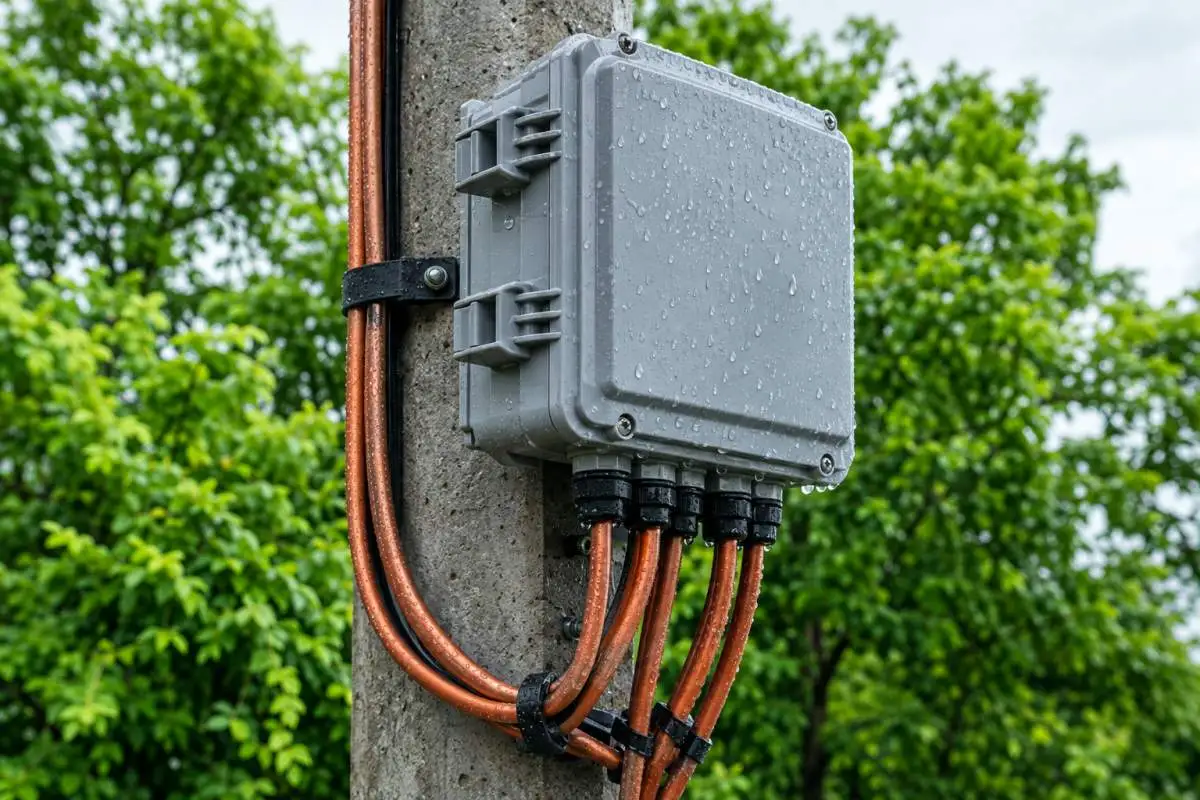
It rains for an afternoon, the video call freezes and the speed test shows half of what you normally get. Then the weather clears and the connection limps along anyway. If your broadband still runs over a copper telephone line, as ADSL and most part-fibre connections do, this is not bad luck or a coincidence. Water and old copper make a poor combination, and the way your line protects itself can keep it slow long after the sky clears.
Why water drags the speed down
Copper broadband sends a high-frequency electrical signal along two twisted copper wires. When moisture gets in, it changes the electrical behaviour between those wires and injects noise into the very frequencies the connection uses. The signal-to-noise ratio falls, so your router and the equipment at the exchange or street cabinet renegotiate a lower speed until they find a safe margin again.
Where the water gets in matters, because it tells you what kind of fault you have.
A fault that appears with every shower usually points to a box or a cable sheath that lets water in and dries out. A fault that persists after the rain means water is sitting in the cable. That is more serious, but a fault you can measure at any time is easier to get your provider to recognise.
Why the speed does not always come back
Here is the part most people miss. After repeated dropouts, the automatic system that manages the line, known on the Openreach network as Dynamic Line Management, raises the noise margin to keep the connection stable. That margin can stay high for days, or for good. The line stops cutting out, but it is capped.
This also explains why two neighbours on the same cabinet can get different speeds: each line carries its own history of dropouts. And it is why rebooting the router is a trap. Every restart counts as one more incident, which pushes the system to keep the margin high.
How to build a case your provider cannot ignore
Your contract is with your broadband provider, not with Openreach, so that is who you deal with. The aim is to get an engineer to look at the line, not a remote reset.
- Stop restarting the router and leave it on through several dry days, so the line management can bring the margin back down.
- Record speed and noise margin from the router's admin page, once on a dry day and once on a wet one, with screenshots and the date.
- Run a speed test over a cable rather than Wi-Fi, at different times, to rule out your home network.
- Report the fault in writing and keep the reference number.
- Ask for an engineer to test the line up to the external connection point, mentioning that the fault follows the weather.
Our broadband speed test guide explains how to get readings a provider will take seriously. If the complaint drags on, Ofcom rules let you take it to your provider's alternative dispute resolution scheme free of charge once eight weeks have passed without a fix, or earlier if the provider sends a deadlock letter.
When the line simply cannot cope any more
Some copper lines will never be properly repaired, especially where full fibre is being built and investment in the old network is winding down. In that case, waiting rarely pays.
- Check whether full fibre has reached your address: light travelling through glass is unaffected by damp and corrosion.
- Look at 4G or 5G home broadband if mobile coverage is strong where you live.
- Avoid signing a new long contract on copper: a rolling deal lets you move the day fibre arrives.
Our guide to no-contract broadband lists the options that keep you free to leave. One point to check before you switch: a landline moved to a digital service no longer works in a power cut unless you have a backup, and providers must offer a solution giving at least one hour of access to emergency calls to customers who depend on their landline.