
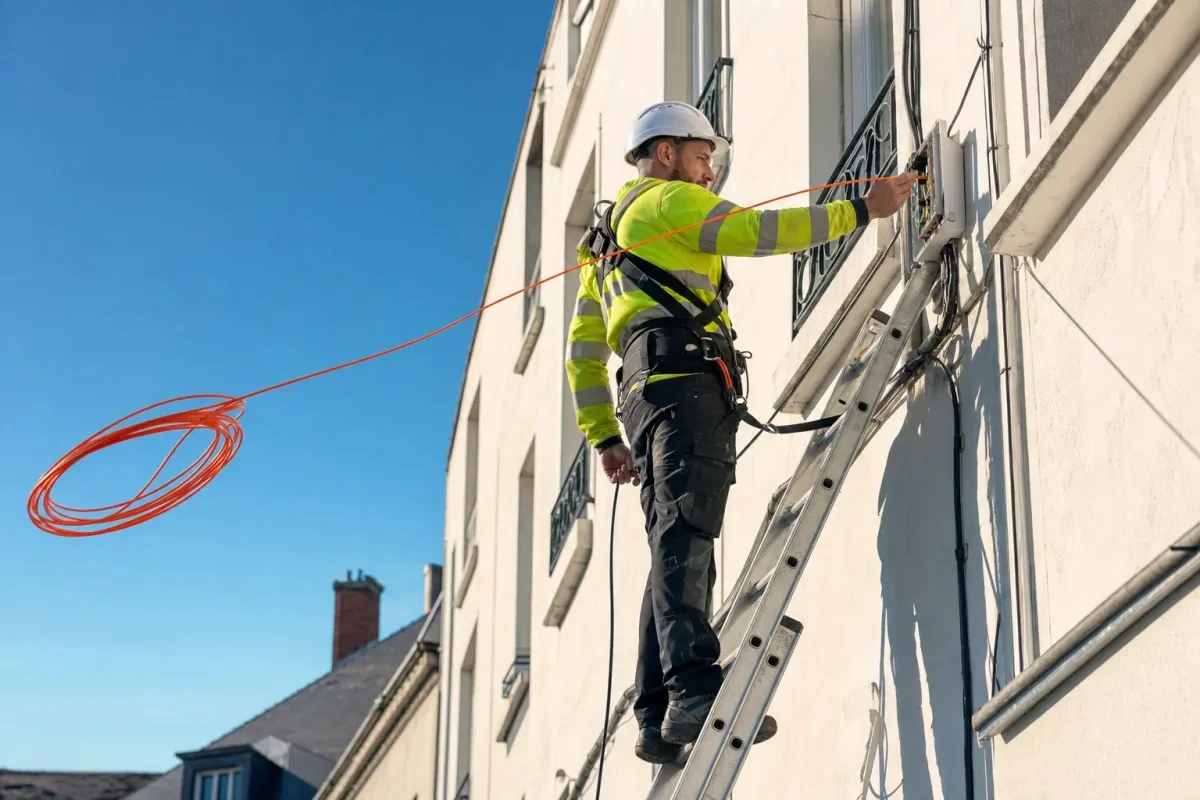
The postcode checker says full fibre is available. You order it, a date is confirmed, and the engineer turns up, spends forty minutes outside and leaves without connecting anything to the house. A week later the order is still open, nobody can say what happens next, and the line you were about to cancel is the only reason you still have broadband. This is one of the most common broadband complaints in the country, and almost none of it is under your provider's control.
What "available" on the checker really means
Available means the network has reached your street and your address has been recorded as serviceable. It says nothing about the last stretch, the one that runs from the chamber in the pavement, through a duct, up a wall and into your living room. That final drop is a separate piece of engineering, and it is where installs fail.
There is no national figure to quote. Ofcom publishes how many premises full fibre has passed, not how many installs fall over on the day, so anyone who quotes you a failure rate is making it up. What is measurable is your own order, and the reason it stalled will be one of four things.
The four blockages, and who has to clear each one
The first line is the good news and it is also the most frequent. Addresses go missing, get merged with the flat next door or sit under the wrong reference in the database, and the fix is a record change rather than a spade. Quote your address exactly as the Royal Mail postcode finder prints it, flat number included, and ask your provider to have the record corrected.
The last line is the one people aim at the wrong target. In a block of flats, fibre reaching the front door is not the same as fibre reaching your floor, and no operator is allowed to build inside the building until the freeholder or the managing agent has signed a wayleave. If nothing has ever been cabled into the block, the person holding up your broadband is the managing agent, not the call centre. Where a freeholder simply never replies, operators do have a route to apply for the rights they need, but it is slow, so it is worth writing to the agent early, with the operator copied in.
Your provider is not the network
At a given address the physical fibre belongs to one infrastructure company, usually Openreach, sometimes CityFibre or one of the smaller altnets. On an Openreach footprint, ordering from a different retail brand puts you on the same duct, the same splitter and often the same engineer. Switching provider to escape a failed install changes the billing name and nothing else.
One thing does depend on who you buy from: how hard they chase. Retailers vary a great deal in how quickly they raise a fault with the network operator and how often they chase it, which is worth weighing when you look at what is actually available at your address.
The steps, in the order that works
- Put the complaint in writing on the day, with the order reference, the appointment date and whatever the engineer wrote or said. A dated written complaint is the document every later step is measured from.
- Name the blockage and ask what has been raised with the network: a record correction, a civils job, a capacity build or a wayleave. Ask for the reference number of that job, not a reassurance.
- Claim what you are owed automatically. Most large providers are signed up to Ofcom's automatic compensation scheme, which pays a set amount for a missed engineer appointment and a daily amount when a confirmed start date passes without service, as a credit on the bill rather than on request.
- Escalate once the provider has stopped moving. The free route to an independent ombudsman is a subject in itself, and we have set out how to escalate a broadband complaint to an ombudsman step by step.
What to do while it drags on
- Keep the old line running until the fibre is live, and let the switch happen on the day the service actually works. The way a broadband switch is meant to run assumes the new line exists.
- Treat a rolling monthly deal as the stopgap: broadband without a contract or a 4G home router costs more per month but leaves you free the week the fibre appears.
- Run a speed test on the line you already have. A healthy copper connection is worth more than a fibre order that has not moved in six weeks.
- Do not cancel the existing service to hurry things along. It will not hurry anything, and it can leave a household with nothing for weeks.
- Do not reorder with another provider at the same address hoping for a different outcome, unless a genuinely different network serves the street.